In memory of Achim Borchardt-Hume
105 Erased de Kooning Drawing, 1953. Erased drawing with label and gilded frame; 25¼ × 21¾ in. (64.1 × 55.3 cm). San Francisco Museum of Modern Art
“I bought a bottle of Jack Daniel’s. And hoped that he wouldn’t be home when I knocked on his door.”1 That’s Robert Rauschenberg, from a video recorded in 1999, around the time the San Francisco Museum of Modern Art (SFMOMA) purchased a group of Rauschenberg’s early works, including his iconic and iconoclastic Erased de Kooning Drawing (1953; 105). Already seventy-four years old, he looks impishly boyish as he describes an artwork that vacillates between being a prank (in the spirit of Marcel Duchamp) and a bedrock of the American neo-avant-garde. It’s perhaps easier, in the twenty-first century, to imagine the intimacy between the young Rauschenberg and the older Willem de Kooning than it is to recall those twentieth-century days when people showed up on your doorstep unannounced, bottle in hand. Rauschenberg’s story recalls the small-town vibe of downtown Manhattan’s art scene in the mid-1950s. The curator Sarah Roberts describes how news of Erased de Kooning Drawing traveled fast in this close-knit world:
Most early viewers likely encountered the work in Rauschenberg’s New York studio, where it hung on the wall, visible to anyone who stopped in on the gregarious artist. The story behind the work was certainly filtering through the city’s art circles in the mid- to late 1950s, as Rauschenberg began telling people that he had erased a de Kooning drawing almost immediately. Passed on by word of mouth, the basic plot points of the story had become known among art insiders by 1957, the year Steinberg later reported hearing about the work and being so perplexed that he picked up the phone to call the artist for clarification.2
Leo Steinberg, the critic in question, recounted later, “The piece had not been exhibited; you heard of it by word of mouth.”3 Here, we might catch another whiff of how informal the art world once was: small enough that most folks saw the work in Rauschenberg’s studio long before it became a treasured museum object; intimate enough that gossip carried the news of art-historical breakthroughs; collegial enough that critics could call artists to check the veracity of such news.
No matter how you learn about Rauschenberg’s Erased de Kooning Drawing, it comes with a story, one hinted at in its title. Indeed, the work is an object lesson in how art is never autonomous. All art comes to have meaning through narration. All art is dependent on a caption, a backstory, a context from which it emerges. One of the many effects of Erased de Kooning Drawing is to gesture toward the supporting characters, the framing devices, and the labor that goes into maintaining the category of Art. Hence, every account of Erased de Kooning Drawing must rehearse the tale leading up to the work. This is such a consistent attribute of the work’s reception that it is safe to say that the backstory is as much a part of the work as the work itself. This account is no different.
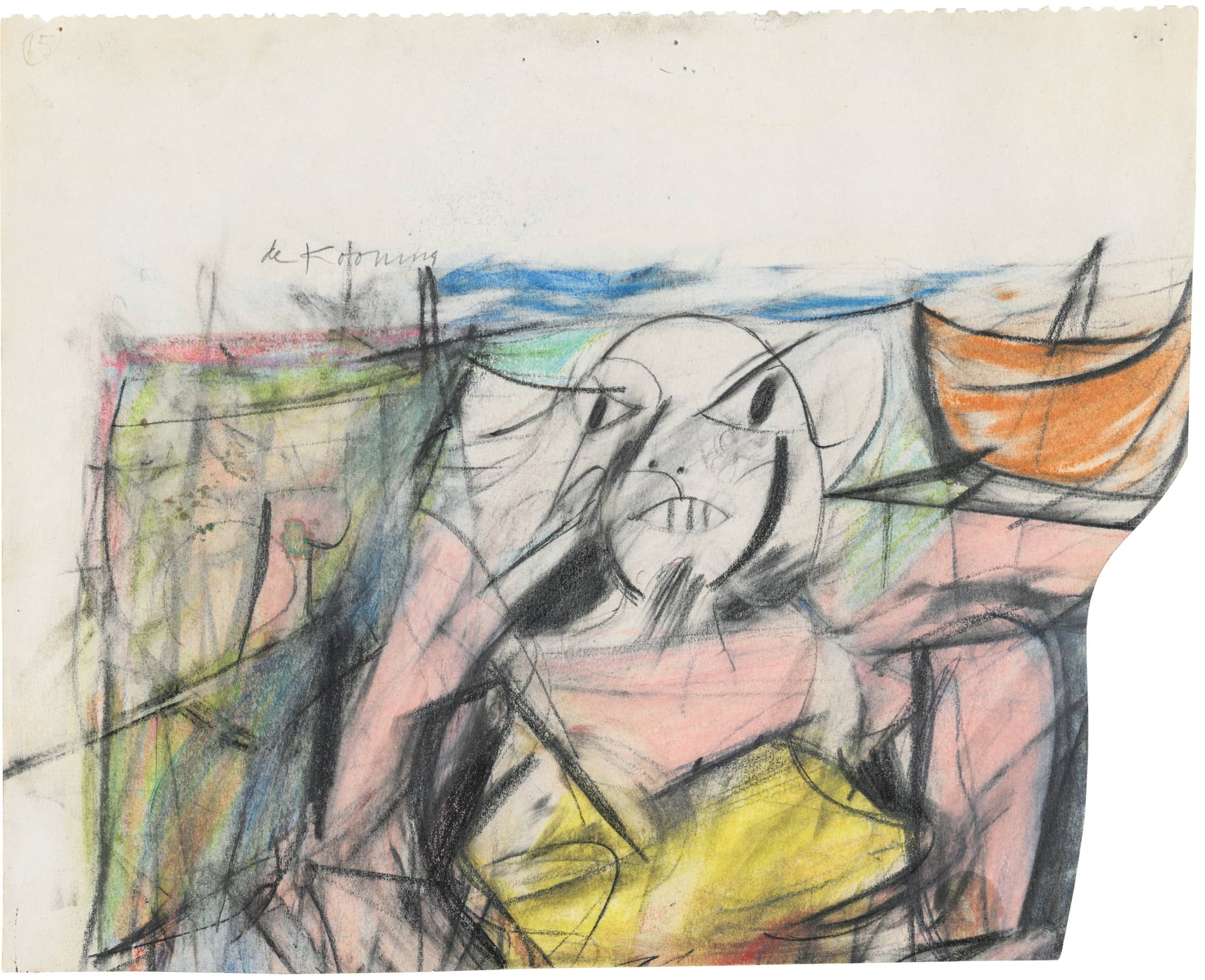
Fig. 1. Willem de Kooning, Woman I, 1952. Pastel, crayon, and pencil on paper; approx. 9 × 11¼ in. (22.9 × 28.5 cm). National Gallery of Art, Washington, D.C.
After Rauschenberg achieved the affectless surfaces of the White Paintings (1951), he turned his attention to making a drawing that would behave similarly. “I love drawing,” he says in the SFMOMA video, his voice adding a touch of emphasis to establish his bona fides in this arena.4 The act of putting white paint on a canvas in a manner akin to the application of house paint, utterly devoid of brushstrokes, was an exercise in both covering up and making clean. The goal was to traffic in blankness. What would be the medium-specific analogue in drawing? This led him to think about erasure. Having learned from Josef Albers, his instructor at Black Mountain College, that any color was as good as any other color—so much so that choosing between colors was merely a matter of personal preference—Rauschenberg was primed for the realization that making marks and erasing marks might also have a similar valence.
He started by erasing one of his own drawings but was quickly dissatisfied. In the SFMOMA video, Rauschenberg (still) looks a touch mystified when he says, “It wasn’t art yet.”5 For the erased drawing to be art, the original drawing had to be a work of art. Such are the contours of his explanation as to why he chose de Kooning: because he was the “best-known” artist, because his work was “indisputably considered art.”6 In addition to seeing drawing and erasure as forms of personal preference à la Albers, I think Rauschenberg also understood one of the most trenchant implications of the Duchampian readymade: Art is what other people value as art. And: Art requires context. (This lesson was also offered by the composer John Cage’s 4'33" [1952], which only “works” because of the context of the concert hall, the grand piano, and David Tudor appearing in a black tuxedo to perform the piece.) In 1953, de Kooning was a confirmed Artist, whereas Rauschenberg was still on his way.
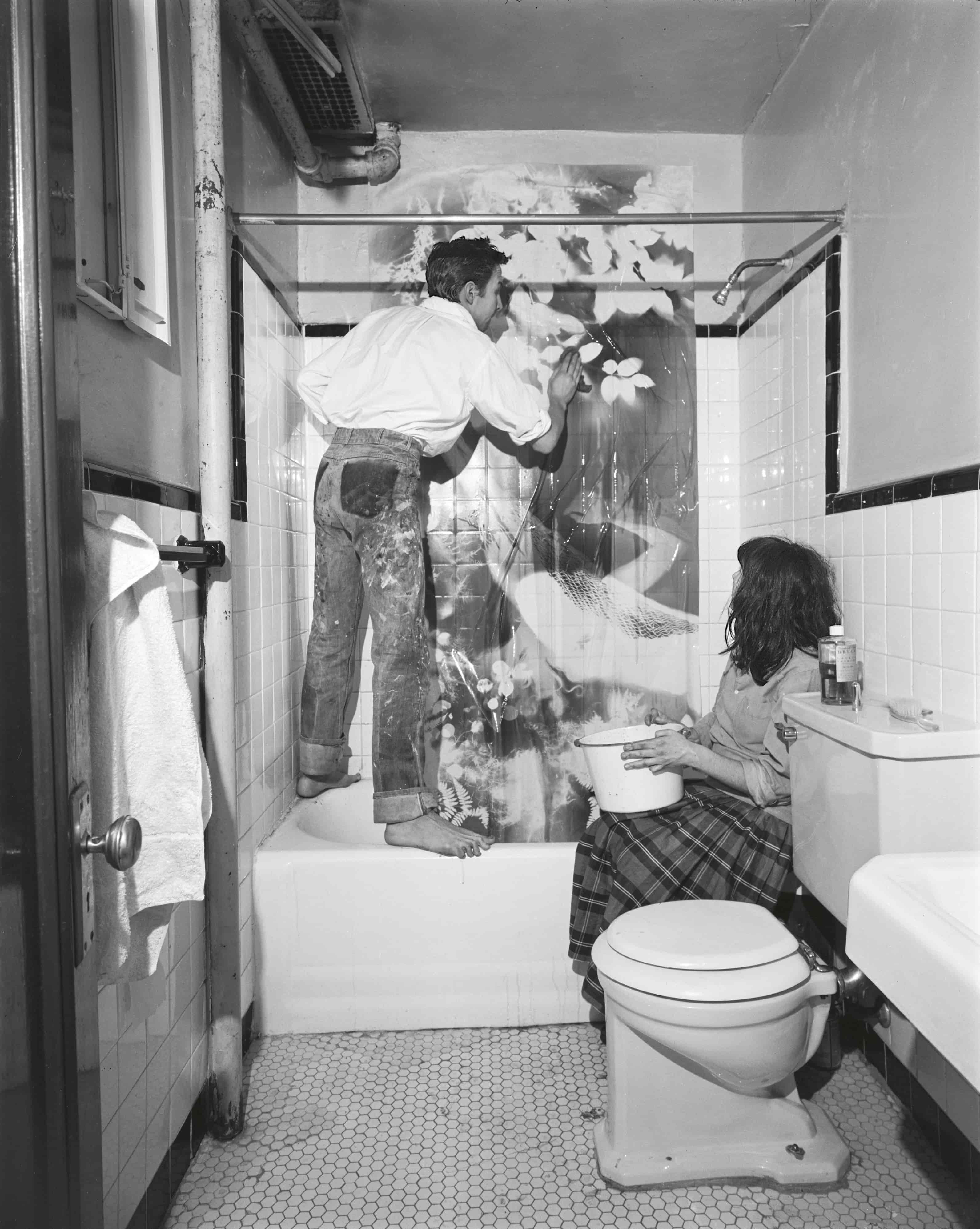
Fig. 2. Robert Rauschenberg and Susan Weil making cyanotypes in their West 95th Street apartment, New York, 1951
As they drank the Jack Daniel’s, Rauschenberg explained his idea, and while de Kooning said he didn’t like it, he decided to play along. The near-mythic story continues: Maybe the booze egged de Kooning on as he looked through multiple portfolios of drawings to pick a work that would be difficult to erase, ultimately choosing one that contained a mixture Rauschenberg described as “crayon, pencil, charcoal.”7 In the same video, Rauschenberg recounts that de Kooning told him he was looking for a drawing he would “miss,” and in the recounting, Rauschenberg betrays a touch of nervousness once the realization struck that this gesture would be as consequential for de Kooning as it was for him.8 David A. Ross, SFMOMA’s director, asks him about the specific de Kooning drawing:
Ross: Do you remember what the drawing looked like, in your mind?
Rauschenberg: It’s part of the Woman series.
Ross: I mean, do you have that image, though, burned into your head?
Rauschenberg: Sort of. It’s not burnt in. And so, when I titled it, it was very difficult to figure out exactly how to phrase this [pointing at the label]. And Jasper Johns was living upstairs. So, I asked him to do the writing.9
Part of the Woman series? Who knows? Apocryphal or not, it’s an indication of the seriousness of the gesture for both men. No one was fooling around (fig. 1).
When Rauschenberg showed up at de Kooning’s door in 1953, he was in his late twenties, while de Kooning was almost fifty. Much has been made of their generational divide: Rauschenberg the brash young American upstart, de Kooning the European old master in the making. Add a touch of iconoclasm and art history’s teleological impulse (with chestnuts about novelty and progress), and it is no surprise that many art historians have narrated Erased de Kooning Drawing as an Oedipal scenario. Steinberg, Rauschenberg’s earliest and most important critic, said, “An Oedipal gesture? Young Rauschenberg killing the father figure? Well, maybe.”10 The critic and biographer Calvin Tomkins wrote, “The implications were so blatantly Freudian, the act itself so obviously a symbolic (if good-natured) patricide.”11 Such suggestions led the art historian Jonathan Katz to opine, “It is as if Rauschenberg’s assertion of self could only be presented as a negation of macho Abstract Expressionist identity, not as an alternative co-equal form.”12
While this makes sense rhetorically, “I bought a bottle of Jack Daniel’s. And hoped that he wouldn’t be home when I knocked on his door” doesn’t exactly read like the opener to vengeful murder or “assertion of self.” Rauschenberg isn’t loaded for bear. There’s no rage, no swashbuckling masculinity to defend or prove, no aesthetic difference masquerading as political opposition. If anything, the bottle of Jack speaks of nervousness, while “hop[ing] that he wouldn’t be home” is the classic structure of desire. Might it be that Erased de Kooning Drawing is less about hostility and more about aspiration? The writer Catherine Lord intimated just that: “Though Rauschenberg’s motives have been interpreted as violently Oedipal, the labour of erasure would have been slow and delicate.”13 As in, let’s face it, if this was about either Oedipally inflected rivalry or vandalism, then Rauschenberg easily could have torn the thing up. The fact is, he didn’t burn the drawing, he didn’t paint over it, he didn’t destroy it. Rather, he engaged in a process “slow and delicate.” Further, Rauschenberg only erased the drawing, not de Kooning. If anything, the title ensured that Rauschenberg was bringing de Kooning along with him for the ride. Seen this way, Erased de Kooning Drawing is more like a hedged bet. If, in the game of art, Rauschenberg is the victor, he’s showing us his fellow travelers. There is a generosity implicit here. Should de Kooning end up on art history’s trash heap, Rauschenberg’s Erased de Kooning Drawing means that de Kooning won’t be “left behind.” So, too, should a capricious art history relegate Rauschenberg to the dustbin, his name would appear, if nowhere else, as a footnote in de Kooning’s catalogue raisonné.
Central to the legacy of Erased de Kooning Drawing is the cascade of interpretations it has engendered over seven decades. To write about the work is to enter a nearly Talmudic situation. By the time of Rauschenberg’s major museum retrospective in 1976, the drawing had come to be seen as a preeminent piece both in the artist’s body of work and in the history of twentieth-century art at large.14 It is now routine for Erased de Kooning Drawing to be posited as, among other things, the de facto progenitor of conceptual art, of institutional critique, and even of performance—an emblem of the truism that, for mid-twentieth-century art, process is more important than product. Thinking about the drawing from the vantage of the twenty-first century, I want to pick up a slightly less heroic thread. What if, instead, we were to see Erased de Kooning Drawing as offering a model of artistic production—which is also a model of subjectivity—rooted in collaboration and intimacy? This is what leaps out at me when, for example, the art historian Thomas Crow writes of the “complex reflections on paternal and erotic love between men” that much of Rauschenberg’s work provokes.15
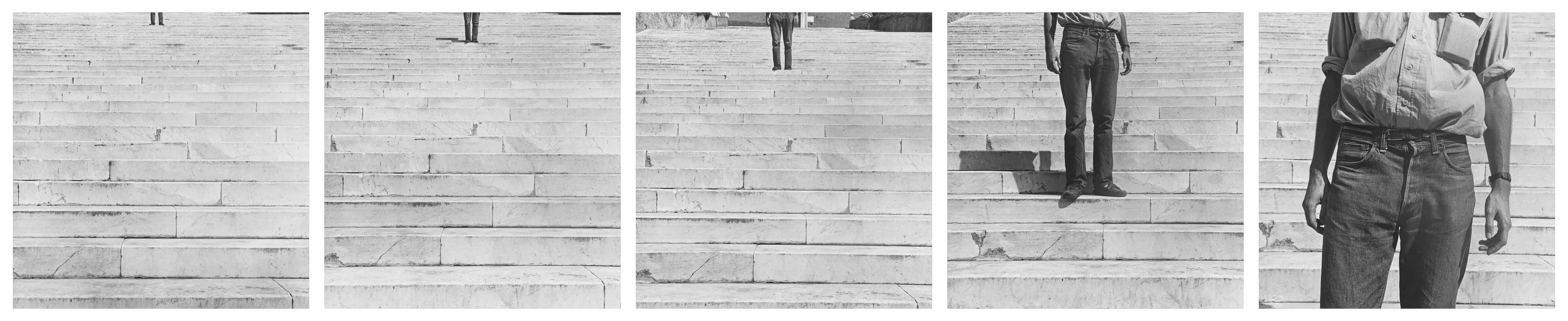
Fig. 3. Robert Rauschenberg, Cy + Roman Steps (I–V), ca. 1952. Suite of five gelatin silver prints; each image 14¾ × 14¾ in. (37.5 × 37.5 cm). Robert Rauschenberg Foundation, New York
To say that our common culture doesn’t have sophisticated language for love between men is an understatement, even more so if one considers the relations between heterosexual and queer men. (“I bought a bottle of Jack Daniel’s. And hoped that he wouldn’t be home when I knocked on his door.”) Seventy years on, in the wake of the mainstreaming and increasing legalization of queer life, the tone of the literature on Erased de Kooning Drawing, owing to its imbrication in a thick network of creative relationships among a close group of male friends, has become demonstrably more tender. The art historian Hal Foster, for instance, describes Rauschenberg’s Fulton Street studio as a place of “definition through dialogue and creation through collaboration.”16 Rauschenberg had engaged in a rich array of creative partnerships before Fulton Street. At Black Mountain College, he was the subject of photographs by Hazel Larsen Archer (as well as being her student) 17and helped make costumes for and appeared in numerous performances, instantiating the college’s blurring of performers and audience—a lesson in switching places as a form of community.18 With the artist Susan Weil, whom he married in 1950, he made cyanotypes (it was she who taught him the technique; fig. 2). He and his work appeared in John Cage’s Theater Piece No. 1 (1952), and he participated in wildly generative conversations involving the composer and Merce Cunningham, which Cage acknowledged when he said, “[Rauschenberg’s] white paintings came first; my silent piece came later.”19 And there were other forms of fellowship and reciprocity with (usually male) artists, such as Alberto Burri, with whom he exchanged works, and Cy Twombly, whom he used as a model in photographs such as Cy + Roman Steps (I–V) (fig. 3). Later in the decade, Rauschenberg made these various affiliations and collaborations explicit in the Combine Short Circuit (fig. 4) by initially including actual works of art by Weil and Jasper Johns, his lover at the time, and eventually, after the Johns was stolen, replacing it with a work by Sturtevant (the ultimate artist-as-collaborator). All of which is to say: One way of looking at Erased de Kooning Drawing is to see it as part of a run of collaborations. Rather than describe it as “aggressive,” we could instead narrate this “slow and delicate” act as one in which Rauschenberg was compelled to trace—to literally go over, to repeat or rehearse—de Kooning’s prior marks. Here, the act of erasing stands in for the time-honored artistic act of copying after a master.
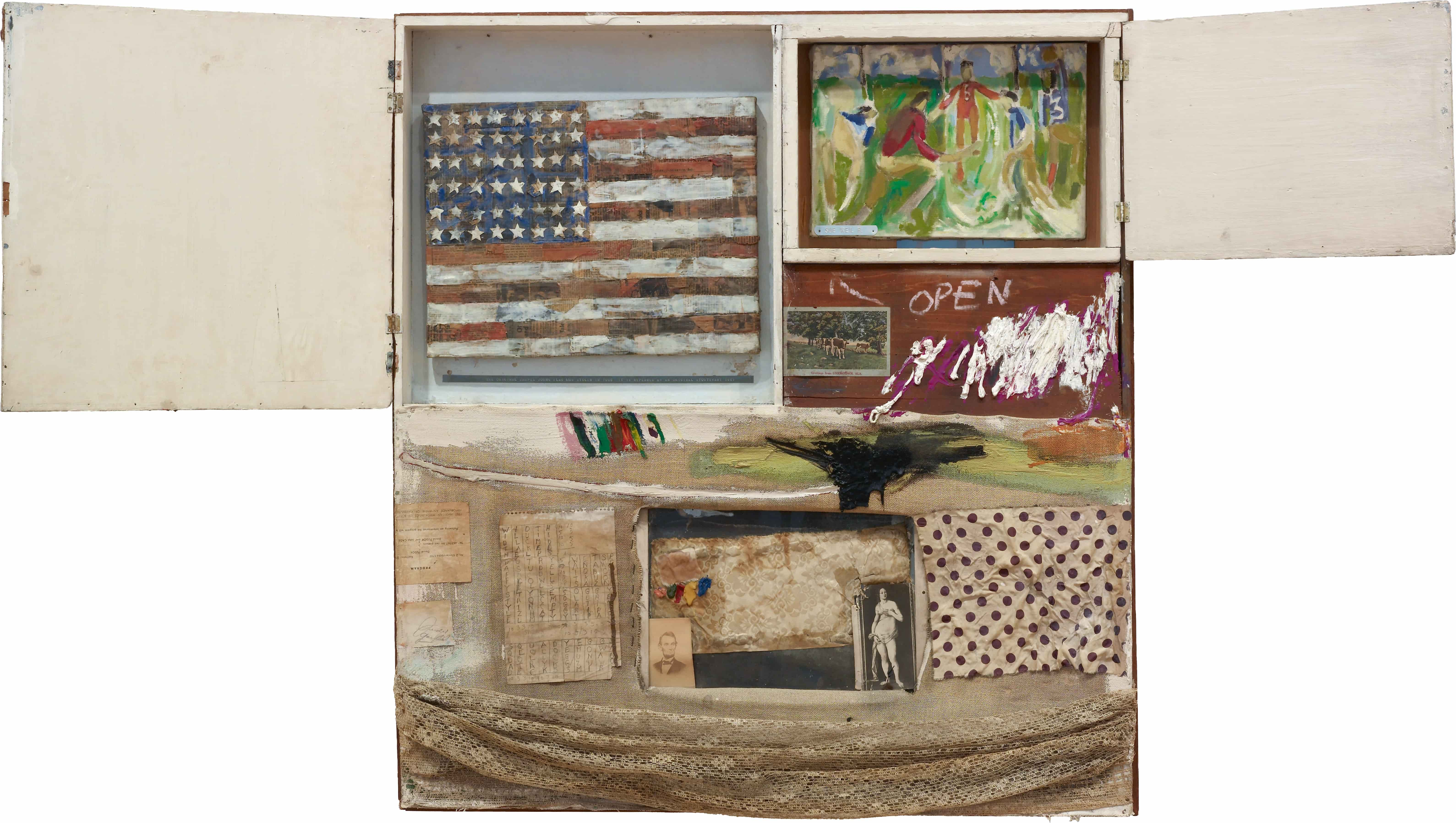
Fig. 4. Robert Rauschenberg, Short Circuit, 1955. Combine: oil, fabric, notebook paper, printed reproductions, postcard, concert program, and autograph on canvas, wood supports, and cabinets with paintings by Sturtevant and Susan Weil; 40¾ × 37½ × 4¼ in. (103.5 × 95.3 × 10.8 cm). Art Institute of Chicago
By reframing this work as a collaboration, we can see more clearly that the work’s ethics are rooted in consent. Everyone acknowledges that Rauschenberg asked de Kooning and that de Kooning said yes, but we tend to bump over this rather remarkable negotiation of power. This is especially pronounced when one considers a pair of prior encounters with de Kooning’s drawings that Rauschenberg described to Tomkins, both of which skirted the ethics of consent: Once, he took home a beer coaster on which de Kooning had doodled during a dinner, and even more jejune, he admitted to having taken a drawing from de Kooning’s studio trash can and photographed works in progress while the artist was away (fig. 5). About this, Rauschenberg said, “It was just total idolizing,” and “I couldn’t use the drawings I’d stolen from him, because the process required his cooperation.”20
I’d like to linger here for a moment, if only in an imaginative way, to express my admiration for both men, the one who asked and the one who agreed, for it is this part of the exchange, more than any other, that signals the near-total absence of (male) aggression. You can hear this lack of aggression, too, in Rauschenberg’s 1999 conversation with Ross:
Ross: I imagine that it had to be done very delicately, so that the paper wouldn’t tear.
Rauschenberg: Yeah.
Ross: I mean, the idea of erasure there was a very delicate piece of surgery. But was it also about a kind of negation? I mean, there seems to be—
Rauschenberg: No.
Ross: —something kind of—
Rauschenberg: No. Like, neither is the White Painting. It’s not a negation, it’s a celebration. It’s just the idea.21
It’s almost as if Rauschenberg doesn’t see himself, in this period, as a solo artist. Or, to put it differently: The litany of collaborators listed above suggests that Rauschenberg saw art, fundamentally, as something you do with others. Here is another passage from 1999:
Oh, I love collaborating, because art can be a really lonely business, if you’re really just working from your ego. … And when you have two people thinking at the same time about a single outcome, or object, well then, it’s just like—it’s multiplied and mirrored back and forth, until it becomes, you know, like a whole group of brains and feelings and solutions. And that’s why I like collaborating.22
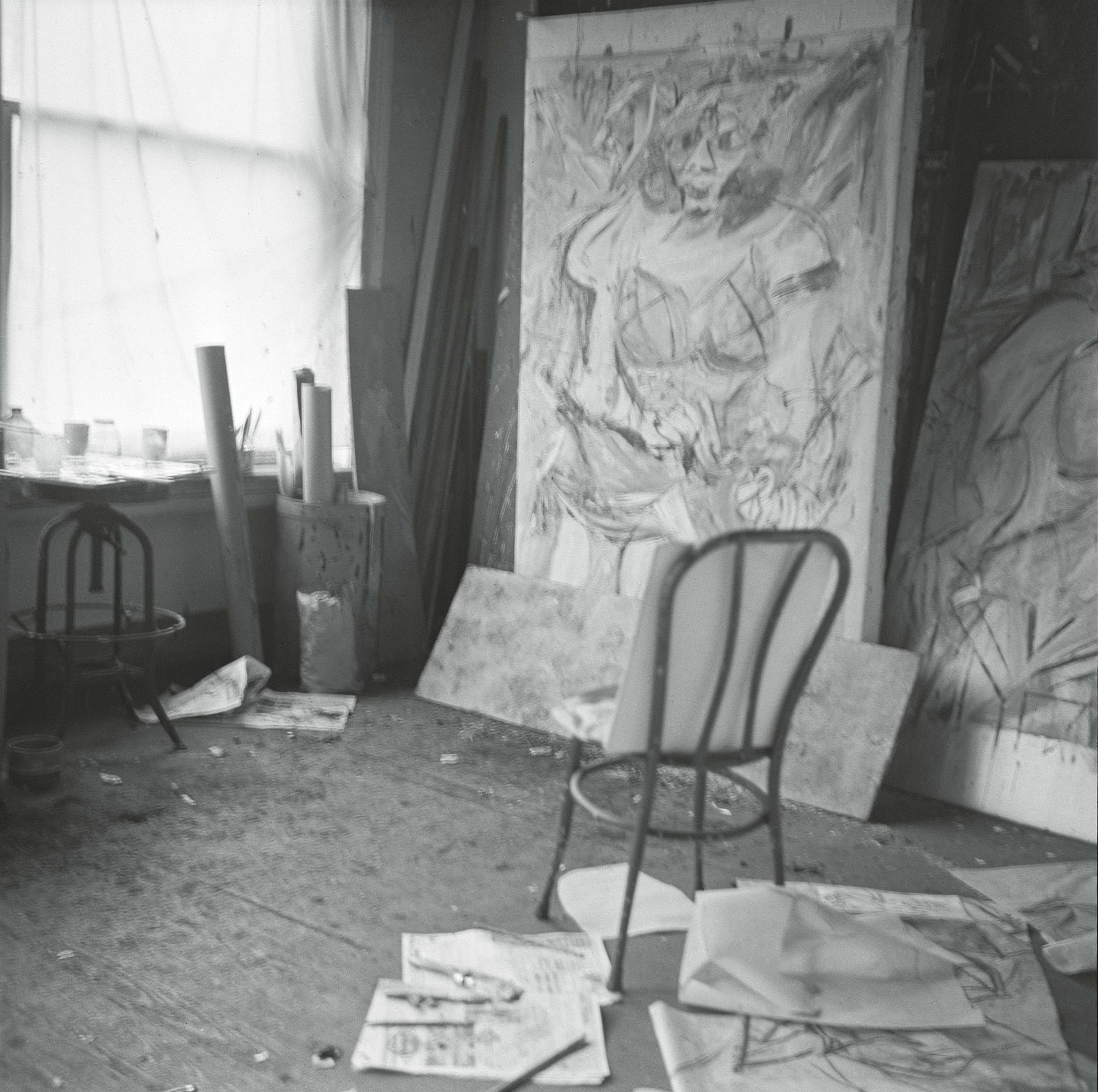
Fig. 5. Early states of Willem de Kooning’s Woman II (The Museum of Modern Art, New York) and Woman III (private coll.) in the artist’s studio, 85 Fourth Avenue, New York, spring 1952. Photograph by Robert Rauschenberg
This logic is evidenced by the very title of Erased de Kooning Drawing: How many other works of art (other than portraits) can you think of that foreground the name of an artist other than the one who made it? Rauschenberg’s sense of collaboration wasn’t bound up simply with making something with someone else. The title is the key: Rauschenberg was interested in doing things in his work that other people did in their work. Steinberg pointed out that erasure was part of de Kooning’s own drawing repertoire; he was “the one who belabored his drawings with an eraser.”23 Rauschenberg’s collaboration rides slipstream on the older artist’s practice, inhabiting it like an avatar, as if extending his own artistic subjectivity by absorbing the methods of another artist. This happens again with the inclusion of the title in the matted and framed version of Erased de Kooning Drawing. The label smuggles in yet another collaboration, albeit a tacit one, with Jasper Johns (fig. 6). In a 2024 email, Johns writes, “When he told me that he had nothing to contribute to a drawing show at the Poindexter, formerly the Egan, Gallery, I suggested that he show the de Kooning. It was then labeled and framed.” 24For its first public appearance, the drawing was mounted in a “thin gold frame with a plain window mat” and labeled with a “machine-precise inscription.” 25Johns made the inscription with a mechanical writing device that mimicked typesetting, akin to a pantograph. If Rauschenberg’s choice of a de Kooning drawing acknowledged the centrality of drawing and erasing to de Kooning’s practice, so, too, are Johns’s specific aesthetic interests—think stencils—foregrounded in his participation in the work.
Furthermore, the work is an instance of Johns’s and Rauschenberg’s interest in all things Duchamp and, specifically, the problem of the handmade readymade.26 Surely, the label could have been typeset rather than handmade, just as Rauschenberg could have “simply” used a clean piece of paper and titled it Erased de Kooning Drawing. Instead, all three artists involved foregrounded handwork: de Kooning’s original drawing and his choice of one difficult to erase; the time it took Rauschenberg to erase it; and the work required for Johns to produce the meticulous label.
In the decades-long discursive field produced by this object, it’s also impossible to mention labor and/or work and not again summon Steinberg, Rauschenberg’s critical interlocutor; we might think of this conversation as yet another instance of collaboration, more “complex reflections on paternal and erotic love between men.” For Steinberg, Rauschenberg’s oeuvre enacted an epistemological shift in orientation from the vertical—stemming from painting’s historical relation to a window—to the horizontal, for which the critic offered the hermeneutic of the “flatbed picture plane.” Here is Steinberg’s well-known description: “The flatbed picture plane makes its symbolic allusion to hard surfaces such as tabletops, studio floors, charts, bulletin boards—any receptor surface on which objects are scattered, on which data is entered, on which information may be received, printed, impressed—whether coherently or in confusion.” This shift meant, moreover, that the “psychic address of the image, its special mode of imaginative confrontation,” is the “tilt of the picture plane from vertical to horizontal.”27
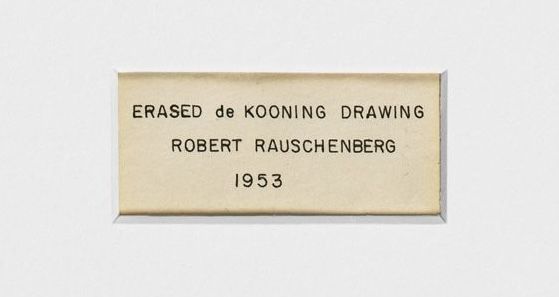
Fig. 6. Robert Rauschenberg, Erased de Kooning Drawing, 1953 (detail of 105 showing label)
What could be more horizontal than erasing? And what could indicate artistic labor more than erasing—gesturing, as it does, toward a job not well done or, by contrast, to a job so well done you can’t even see it as labor (like a well-cleaned house)? Similarly, the submerged nature of Johns’s participation gestures to the unseen institutional labor that supports the category of Art, such as matting, framing, labeling, and cleaning, often done by back-of-house staff such as conservators and registrars—demonstrating the degree to which art’s legibility requires that custodial labor remain unauthored and invisible so as to shore up and protect the proper name of the artist.28 But if Erased de Kooning Drawing makes an issue of various forms of artistic and custodial labor, as I think it does, we must still ask what Rauschenberg called on them to do; I’m not at all sure that Rauschenberg was conscious of, or intentional about, this resonance at the time. And if the labor was partly custodial, might it also have been partly preparatory? Sarah Roberts suggests that John Cage intimated as much when he “penned an article on Rauschenberg that also fleetingly (and obliquely) mentions the drawing, framing it as a moment of slate-cleaning: ‘It’s a joy in fact to begin over again. In preparation he erases the De Kooning.’”29 Might we infer that Erased de Kooning Drawing was preparatory, “slate-cleaning,” in relation to the flatbed picture plane as such?30 Good cooks know you can’t cook in a dirty kitchen. Did Rauschenberg erase the de Kooning drawing, lovingly and with great attention, the way a cook wipes down the knife, the counter, the work surface, and the edge of the serving bowl? Rauschenberg was notoriously messy, but it seems that much of that messiness—and by messiness, I mean the Combines—happened in the wake of Erased de Kooning Drawing. By enlisting others to help him achieve this clean slate, did he extend his interest in collaboration among friends—a social horizontality that mirrors the flatbed picture plane? Did this extension help him invent an alternative to an art history structured on combative, Oedipal toppling of vertical hierarchies? Was this what he meant when he told the critic Barbara Rose, “I was trying to make art, and so therefore I had to erase art”?31
Situating Erased de Kooning Drawing in this deep network of affiliation, collaboration, copying, and labor prompts another question: Can we see this work as an update of the twentieth century’s most famous form of artistic collaboration, Surrealism’s exquisite corpse? Erased de Kooning Drawing doesn’t offer an image of the body in pieces. Nevertheless, it is the outcome of an iterative process: de Kooning makes a drawing, Rauschenberg erases the drawing, then Johns labels the drawing. As such, it offers itself as a kind of rebus—an idea Rauschenberg would later pursue both literally and metaphorically in the Combines. Here, the corpse—of Abstract Expressionism, of easel painting, of generational strife and the logic of Oedipal conquest, of artistic individuality—is what appears “exquisite.”
No matter how rich the networked intimacy of his friends and collaborators, when Rauschenberg sat down to do the work of erasing this drawing, he did so alone. We know that he mounted the drawing on a piece of cardboard, and it is assumed that he did so to ensure that the paper wouldn’t move around, to decrease the possibility of a tear.32 The conservators with the most intimate knowledge of the drawing do not describe the paper as being particularly abraded, which lends credence to the idea that Rauschenberg’s work was “slow and delicate.” We know from his own accounts that the work was time-consuming and difficult (“I spend four weeks erasing that drawing”), and in nearly every telling, he mentions that he went through a lot of erasers (“I used about fifteen different types of erasers”).33 This is interesting in itself, as I’ve rarely heard an artist talk about an artwork’s having “used a lot of paint” or “used up a box of pencils.” It speaks of Rauschenberg’s need to highlight and quantify his labor. But more than labor, this odd fact—that an eraser disappears, as does the thing erased—leads me to a set of questions about Erased de Kooning Drawing to which I have no answers.
The title’s term “erased” spotlights the artist’s activity and process. And it foregrounds his tool: an eraser. The wall label at SFMOMA and the tombstone caption in the museum’s online collection, on the other hand, do no such thing. The museum classifies the work as a “drawing” and offers the following description of its medium: “traces of drawing media on paper with label and gilded frame.” No mention of an eraser. Because there’s no other medium quite like this: a medium expended in its use, a medium that doesn’t leave a mark save for the faint “halos” visible on an otherwise blank piece of paper—which, in truth, are the residue of the erased drawing itself (graphite, crayon, and so on). Museological classification is pragmatic; my more metaphorical cast of mind wants to posit that the erasure of the eraser signifies loss itself. If we can posit that Erased de Kooning Drawing is less about competition and more about collaboration—if we can see it as something intimate happening between people who share the intimacy of making and believing in the same thing: art—then might we see that it is the status of this loss that the drawing does so much to frame and protect? The label draws our attention to this loss. Did de Kooning understand the work to be about loss when he chose a drawing he would “miss”? To have destroyed the drawing without permission, to have torn the paper: These would have been cataclysmic destructions. But to erase, to engage in “slow and delicate” frottage, to trace another man’s marks: This suggests a different kind of loss. This loss is more akin to the loss of notes in Cage’s 4'33". This loss is more like the absence of painterly marks in the White Paintings.
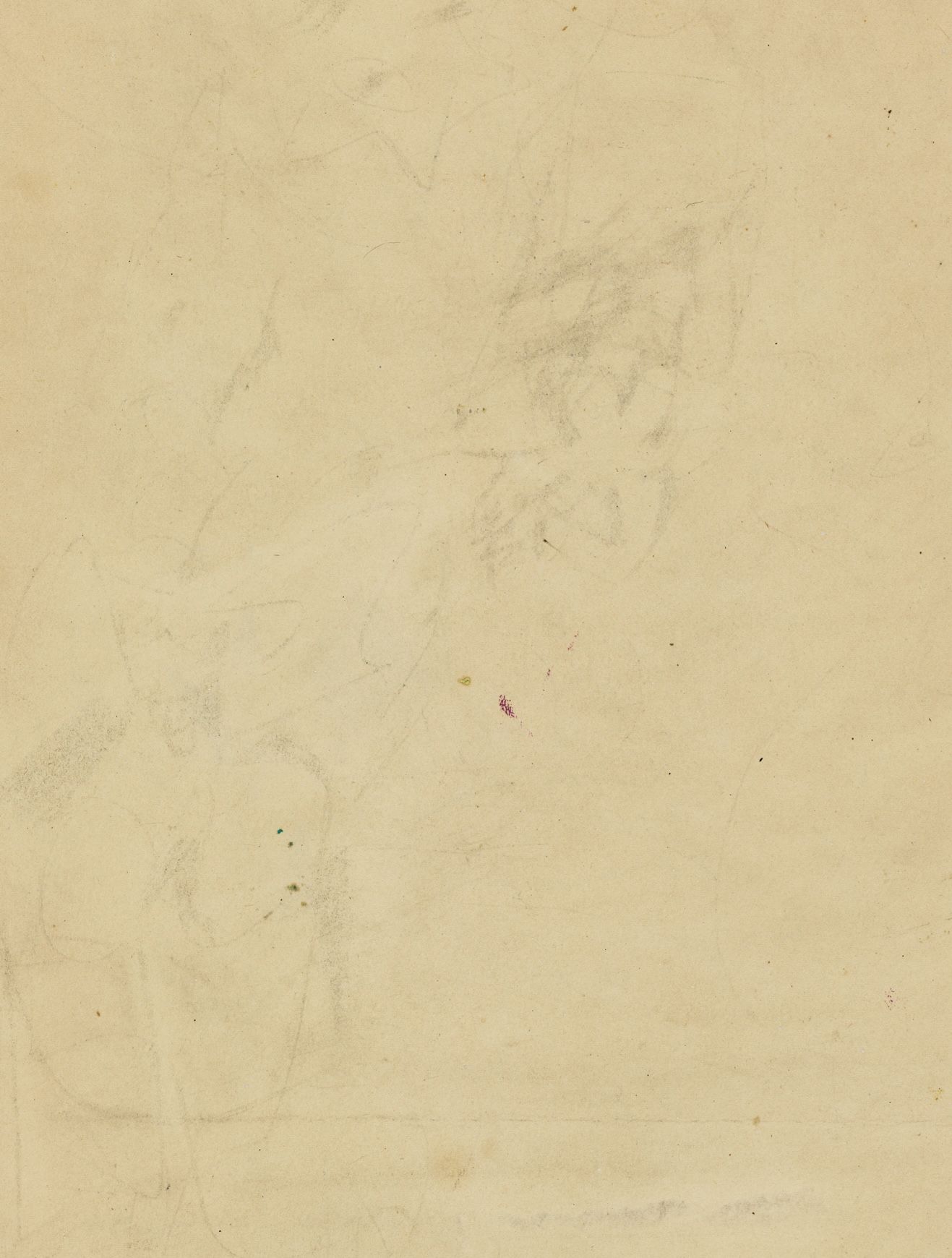
Fig. 7. Robert Rauschenberg, Erased de Kooning Drawing, 1953 (detail of 105 showing center)
These are the type of losses we don’t recognize (or grieve) as such. These are losses that made room, losses that were generative. But lest such talk feel too triumphant, I suppose we must also ask: If the losses were so catalytic, why did Rauschenberg never repeat this gesture? I think the answer might reside in the same affects, tenderness and intimacy, that Erased de Kooning Drawing set into motion as soon as Rauschenberg turned up at de Kooning’s door with a bottle of Jack. Namely, once he’d negotiated the loss of both the drawing and the erasers, he understood how carefully one must proceed in the face of loving people and making (new) things. Perhaps he understood that erasure is linked indelibly to another (psychic) operation—namely, remembering. This may account for his answer, when asked why he didn’t sell Automobile Tire Print (104), the White Paintings, or Erased de Kooning Drawing over the years, why he kept these works with him in the studio for so long: “Well, most of the works in this collection scared the shit out of me, too. And they didn’t stop frightening me. And so there was a kind of courage that was built into them, in their uniqueness, in their individuality, that I didn’t want to forget about, either.”34
There’s collaboration, and there’s individuality. We tend to subject this difference to a hierarchical binary. When it comes to the history of art in the West, we have a long history of privileging the individual, punctuated by bursts of revolutionary impulses when we sometimes privilege our wish for collaboration. But there is another model, in which neither the individual nor the collaborative is demonized or lionized, and that is the logic of the team. Leaving aside for the moment our knee-jerk sense that there is an antipathy between art and sports, what if we saw the Fulton Street gang (Cage, Cunningham, Johns, Twombly, and others) as a team? Was this group of mostly young men (all of whom were exploring not only art but their identities as intimate and sexual beings) tossing around ideas the way a ball is passed on a basketball court? A great basketball play is one in which everyone gets their “touches.”35 Yes, the bucket is the ultimate goal—but great players know that great plays are rarely, if ever, made by an individual alone. Great plays involve several members, even the whole team. And the aesthetic propositions being passed around and shared by the Fulton Street gang were enactments of a range of plays that go by names/ideas such as silence, emptiness, the tacit. The commitment to process over product is crucial to this model of art making. This model suggests that the infinite variety offered by repetition (passing around the same proposition or problem for each individual to try and “solve”) is punctuated by moments of breakthrough, of greatness, while always holding on to the knowledge that such greatness is imbricated in and dependent on the logic of the team. Rauschenberg was a franchise player, to be sure. Conceptual and aesthetic virtuosity was his handle. But even the greatest players are only as good as their team: Most of the time, someone passes you the ball before you dunk it.
How does one retain the knowledge learned and feelings felt during such teamwork, from such ineffable collaborations? The deep truth about teams is that they are provisional. They don’t last. They break up or break down. Often, their greatness cannot be sustained for long. Their lifespan is shorter than that of an individual. Like the eraser that disappears through use, the magic of teamwork also dwindles.
It’s hard to know exactly what “scared the shit” out of Rauschenberg. Was it the audacity of his team’s greatness? Was it that the bar was suddenly set so high? Was it the inevitable dissolution of these collaborations? What we know is that he kept these works for a long time and that, when he finally let them go, he made certain they would remain together. I think he did so to ensure that it wasn’t only the individual acts of “courage” that remained but also some residue of the intimacy between the members of that community—that the courage to act in concert and consent with one another could be remembered, rather than erased, by (art) history. One of the many truths of collaboration, especially the forms of it that privilege everyone’s getting their touches, is that such memories must be tended to, because—in the immortal words of Bob Dylan, singing in collaboration with a team so cool it was simply called “The Band”—it is up to every player to “take care of all of your memories … for you cannot relive them.”36
Rauschenberg, “Robert Rauschenberg Discusses Erased de Kooning Drawing at SFMOMA, May 6, 1999,” interview by David A. Ross, Walter Hopps, Gary Garrels, and Peter Samis, May 6, 1999, San Francisco Museum of Modern Art, video, at 8:35, https://www.sfmoma.org/research-materials/edek_98-298_031/. [In 1953, de Kooning lived and worked at 88 East 10th Street, near Astor Place, New York. —Eds.]
⤴Sarah Roberts, “Erased de Kooning Drawing,” Rauschenberg Research Project, San Francisco Museum of Modern Art, July 2013, https://www.sfmoma.org/essay/erased-de-kooning-drawing/.
⤴Leo Steinberg, Encounters with Rauschenberg (A Lavishly Illustrated Lecture) (Houston: Menil Collection, 2000), p. 16.
⤴Rauschenberg, “Rauschenberg Discusses Erased de Kooning Drawing,” May 6, 1999, at 6:59.
⤴Ibid., at 7:39.
⤴Ibid., at 7:50.
⤴Ibid., at 10:50.
⤴Ibid., at 10:03. The artist offers a different account in Calvin Tomkins, Off the Wall: A Portrait of Robert Rauschenberg (New York: Picador, 2005); there (p. 88), de Kooning instead rejects certain drawings because he would miss them “too much.”
⤴Rauschenberg, “Rauschenberg Discusses,” at 11:24.
⤴Steinberg, Encounters with Rauschenberg, p. 16.
⤴Tomkins, Off the Wall, p. 87.
⤴Jonathan Katz, “The Art of Code: Jasper Johns and Robert Rauschenberg,” in Significant Others: Creativity and Intimate Partnership, ed. Whitney Chadwick and Isabelle de Courtivron (London: Thames & Hudson, 1993), p. 196.
⤴Catherine Lord, “Closet Organizers (1950–64),” in Art and Queer Culture, ed. Catherine Lord and Richard Meyer (London: Phaidon, 2013), p. 106.
⤴See Sarah Roberts, “Erased de Kooning Drawing.”
⤴Thomas Crow, “This Is Now: Becoming Robert Rauschenberg,” Artforum 36, no. 1 (Sept. 1997), p. 100.
⤴Hal Foster, “‘Made out of the Real World’: Lessons from the Fulton Street Studio,” in Robert Rauschenberg, by Leah Dickerman and Achim Borchardt-Hume, exh. cat. (New York: Museum of Modern Art; London: Tate Publishing, 2016), p. 96.
⤴Archer was then known by her maiden name, Hazel-Frieda Larsen.
⤴Rauschenberg’s early creative partnerships are documented in Helen Molesworth with Ruth Erickson, Leap Before You Look: Black Mountain College, 1933–1957, exh. cat. (Boston: Institute of Contemporary Art; New Haven, Conn.: Yale University Press, 2015).
⤴John Cage, “On Robert Rauschenberg, Artist, and His Work,” Metro (Milan), no. 2 (May 1961), reprinted in Silence: Lectures and Writings by John Cage (Middletown, Conn.: Wesleyan University Press, 1961), p. 98.
⤴Rauschenberg, quoted in Tomkins, Off the Wall, pp. 85, 88. The pilfering is thought to have taken place at de Kooning’s studio at 85 Fourth Avenue, across the hall from Jack Tworkov’s studio, which Rauschenberg visited during his breaks from Black Mountain College. De Kooning moved out of this studio in fall 1952.
⤴Rauschenberg, “Rauschenberg Discusses,” at 12:30.
⤴Rauschenberg, video interview by David A. Ross, Walter Hopps, Gary Garrels, and Peter Samis, May 6, 1999, San Francisco Museum of Modern Art, transcript, p. 27, SFMOMA Archives. The quotation has been edited slightly for clarity.
⤴Steinberg, Encounters with Rauschenberg, p. 19.
⤴Jasper Johns to the author, email, July 18, 2024. [The work’s inclusion in a show at Poindexter Gallery has not been confirmed. It was certainly included in a group show at Pyramid Gallery, New York, Dec. 22, 1957–Feb. 5, 1958. —Eds.]
⤴Roberts, “Erased de Kooning Drawing.”
⤴See Hal Foster, “What’s Neo about the Neo-Avant-Garde?,” October, no. 70 (Autumn 1994), pp. 5–32.
⤴Leo Steinberg, “Reflections on the State of Criticism,” Artforum 10, no. 7 (March 1972), pp. 37–49.
⤴On the intertwining of the custodial and the aesthetic, see “Artist Project: Mierle Laderman Ukeles; Maintenance Art Activity (1973) with Responses from Miwon Kwon and Helen Molesworth,” Documents, no. 10 (Fall 1997), pp. 5–22.
⤴Roberts, “Erased de Kooning Drawing”; Cage, “On Rauschenberg,” p. 101.
⤴Steinberg argues that Rauschenberg is trying to get rid of drawing (disegno) as such: “He may himself have begun to use the eraser, not in de Kooning’s manner, constructively, but to see drawing expunged.” Steinberg, Encounters with Rauschenberg, p. 20. I confess that I diverge from Steinberg here, who, I think, was holding on to a category of art and hence also to a category of its destruction. I don’t see Rauschenberg as having that kind of destructive or willful iconoclastic energy; I see him as trying to figure out how to make things. In this period, he is doing that with others, and one way he does so is to have an almost avatar-ish relationship to the operations of other artists.
⤴Rauschenberg, quoted in Barbara Rose, Rauschenberg (New York: Vintage Books, 1987), p. 51.
⤴Amanda Hunter Johnson, conservator of works on paper at SFMOMA, telephone conversation with the author, May 8, 2024. The drawing was unmounted by the conservator Dana Cranmer in the late 1980s at the artist’s request.
⤴Rauschenberg, quoted in Rose, Rauschenberg, p. 51.
⤴Rauschenberg, “Rauschenberg Discusses,” at 5:28.
⤴Arthur Jafa, “Artists’ Influencers: Arthur Jafa and Jason Moran,” Art Basel, Dec. 9, 2017, video, at 38:55, https://www.youtube.com/watch?v=LlqD21-a61Y. The artist Arthur Jafa is describing the play of the Golden State Warriors, a professional basketball team in which shared “touch” among players enacts a prayer-like intensification of “intentionality” akin to that of a free jazz ensemble, in which a solo performer can likewise be seen as an “emanation of the group.”
⤴Bob Dylan, “Open the Door, Homer,” recorded with the Band in the basement of Big Pink, West Saugerties, New York, ca. June–Sept. 1967, track 22 on The Basement Tapes, Columbia C2 33682, vinyl LP, released June 26, 1975.
⤴
Helen Molesworth, “Erased de Kooning Drawing: The One Who Asked and the One Who Agreed,” Robert Rauschenberg: Paintings and Sculptures, 1948–1953, Robert Rauschenberg Foundation, 2026, https://catalogue.rauschenbergfoundation.org/essays/erased-de-kooning.