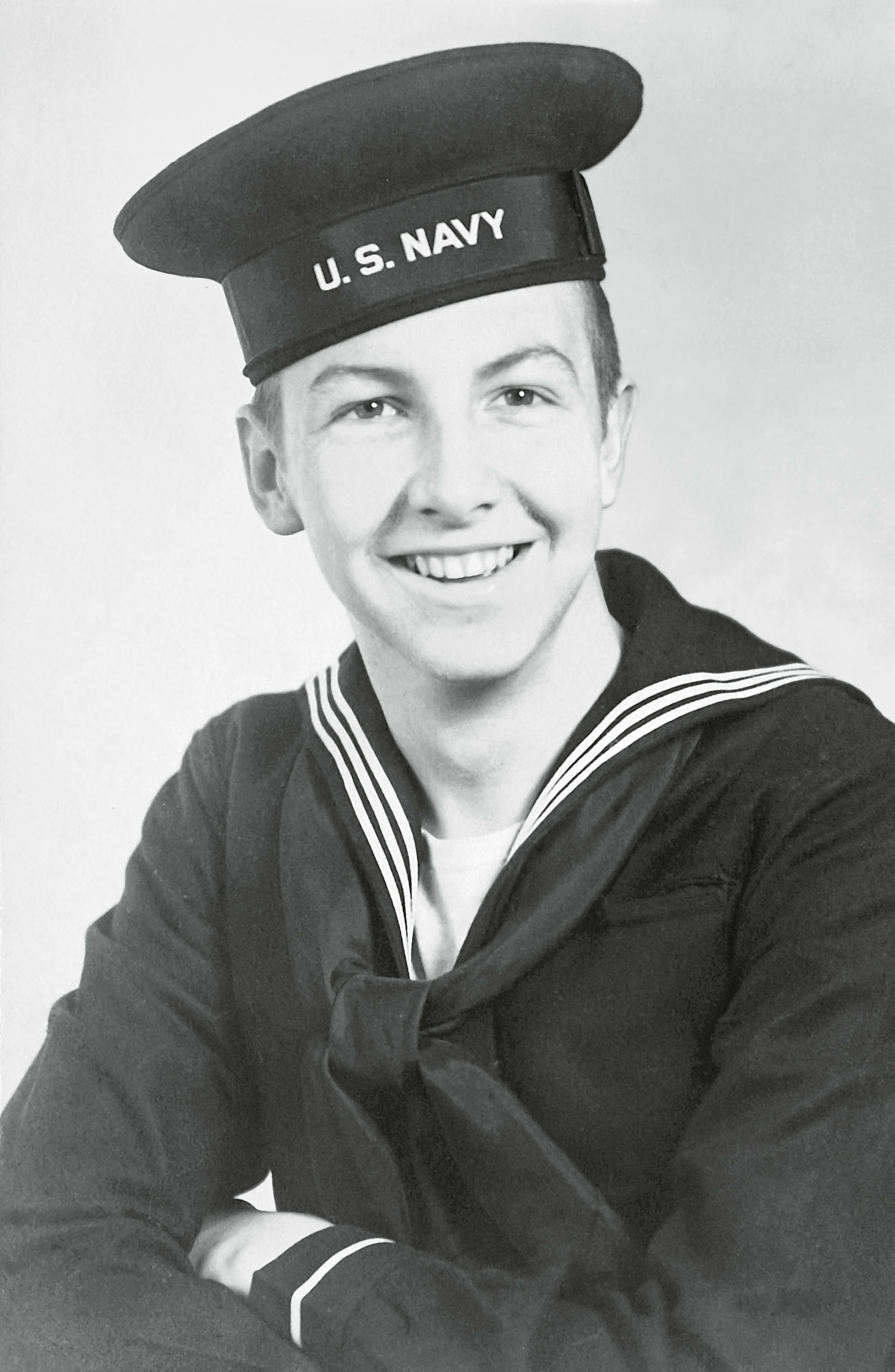
Fig. 1. Robert Rauschenberg in his U.S. Navy uniform, ca. 1944
I am wondering many things about you, how you feel about your life, whether you have realized and attained as you had wished, any regrets—or whether you ever allow yourself the luxury of looking back? … Could any of it have been left out … or has it, like Thomas Wolfe (the earlier one, not the later one—the one from around Asheville, N.C.) who says we are the sum total of every single moment of our lives—is it true—or have there been lots of moments and hours which could have just as well been left out. Sounds as though I am philosophizing and perhaps I am wondering vainly and foolishly, because nothing really changes with the mulling over of it, all that seems to matter is the doing of it, whatever it is that we do.
—Pat Pearman Ludington to Robert Rauschenberg, 1974
Given the apparently exhaustive documentation offered by biographies, monographs, exhibition catalogues, critical studies, journal articles, and oral histories, there would seem to be little to add to accounts of the early life of Robert Rauschenberg, one of the most celebrated artists of the last century. He became an internationally known public figure in the 1960s, and his early biography is well established, with information beyond basic facts provided largely by the artist himself in numerous interviews across nearly five decades. Nonetheless, since Rauschenberg’s death in 2008, archival sources have become available that enrich, complicate, and sometimes contradict previously accepted accounts of his artistic development and interests, as well as his biography.
Most pertinent to his activities in the 1940s are newly accessed records of his U.S. Navy service; applications and transcripts from the schools he attended during this period; correspondence with his parents; and letters, artworks, and ephemera from two additional sources.1 Arthur Welton Frakes, Jr. (1925–2006; fig. 2) was a close friend of Rauschenberg’s from his hometown of Port Arthur, Texas, who went to high school with the artist and roomed with him while they both attended the University of Texas at Austin. Rauschenberg’s letters to Frakes offer a detailed portrait of his life in the Navy during and just after World War II, tapering off after his discharge and ending with his departure for France in late spring 1948.2 While they are less extensive, materials held by the family of Marjorie Pearman Ludington (1922–1978) also provide important insights into another of Rauschenberg’s crucial friendships. Known in the artist’s literature by her nickname, Pat, and her maiden name, Pearman, she was the model for Rauschenberg and Susan Weil’s cyanotype Female Figure of about 1950 (fig. 6), and beginning in the late 1940s, Rauschenberg sent her artworks, postcards, and other materials that shed light on two less documented periods of his life: his brief sojourn in Los Angeles after his discharge from the Navy, and his studies at the Kansas City Art Institute.3
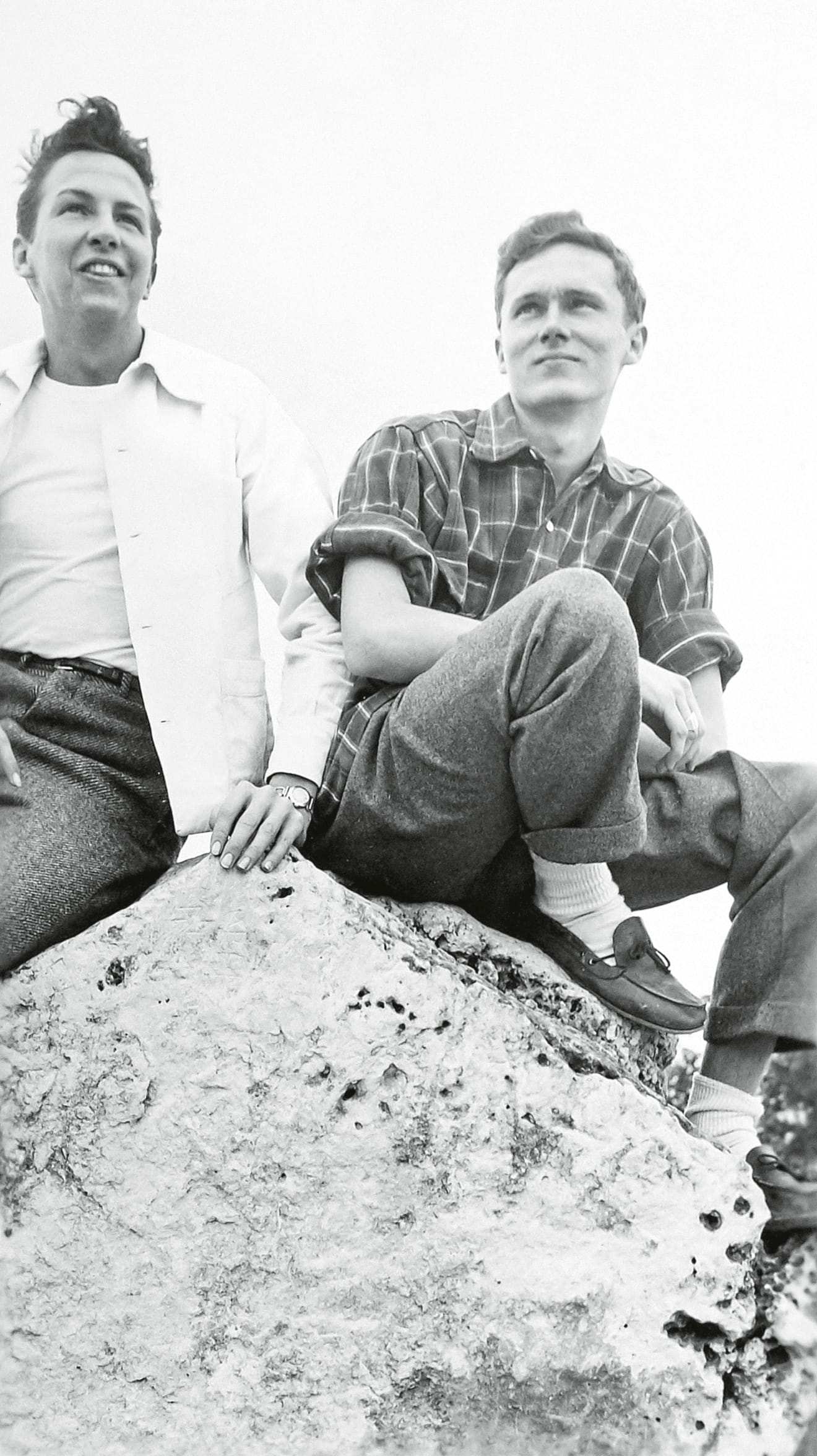
Fig. 2. Robert Rauschenberg and Arthur Frakes, ca. 1943
Rauschenberg’s biography first took published form when he was in his late thirties. In 1963, he was the subject of a retrospective at the Jewish Museum, New York; the following year, he won the top prize for painting at the 32nd Venice Biennale, and Calvin Tomkins published a New Yorker profile that offered the first thorough account of the artist’s early years.4 In discussions with Tomkins and others about his time in school and in the Navy, Rauschenberg may have emphasized what seemed important in hindsight and downplayed, ignored, or perhaps even forgotten other elements. As a result, comparisons of his own accounts of this period with the archival sources mentioned above betray inconsistencies. Although his correspondence of the 1940s reveals a youthful version of the gregarious personality familiar from his maturity, Rauschenberg’s retrospective account of his early adulthood conveyed the impression of a rather shy, isolated loner with few friends.5 For example, a cornerstone of his early biography is that upon his discharge from the Navy in 1946, he returned to Port Arthur only to find that his family had moved to Lafayette, Louisiana, without telling him. Rauschenberg’s letters to Frakes, sent after his discharge and postmarked from Port Arthur, plainly contradict this: The family, in fact, moved to Lafayette in 1948.6 Confronted with such discrepancies, we might recall a 1986 interview in which Rauschenberg referred to the “typically Texan” tradition of the “tall tale” and explained that there is “an extraordinary amount of truth in exaggeration. It’s a way of dealing with the truth.”7
This essay is the culmination of my research into Rauschenberg’s activities before his admission to Black Mountain College in 1948, which I began to consider shortly after the completion of An Audience of Artists, my 2012 book on Dada, Abstract Expressionism, and Neo-Dada.8 The impact of World War I on participants in Dada is taken as a given in the literature on that movement, but there has been comparatively little examination of the role World War II may have played for American artists of Rauschenberg’s generation.9 What follows began over a decade ago as a reckoning with Rauschenberg’s military service, but the sources that shed new light on his time in the Navy also provide unexpected insights that have changed my understanding of the years prior to his study at Black Mountain College and of the artist he eventually became. In the process, I have tried to take into account the “extraordinary amount of truth” that Rauschenberg prized in exaggeration.
Rauschenberg began taking classes at the University of Texas at Austin in summer 1943, intending to major in pharmacy—a substitute for his initial plan to become a veterinarian. His parents had encouraged him to attend Texas Agricultural and Mechanical College (Texas A&M) in College Station, the practical choice for pursuing a degree in veterinary medicine in Texas at the time, but also a quasi-military school with a campus culture defined by the school’s Corps of Cadets. As Frakes and other high school friends were going to the University of Texas, Rauschenberg, not surprisingly, wanted to join them.10 Although he apparently stopped attending classes before the end of the fall semester, his aborted major in pharmacy may, paradoxically, have set him on the path that would determine the direction of his military service.
Upon his induction into the Navy and the accompanying medical exams in Houston in January 1944, Rauschenberg was classified USN-I (Special Assignment—Defective Vision): His eye exam had revealed a deficiency strong enough, even with glasses, to restrict his possible assignments.11 His embarrassment about the classification is suggested by a letter to Frakes in which he wrote, “I guess your mother told you I can’t be sent into any actual combat area because of my eyes. Don’t tell anyone though, Arthur. I had just as soon people didn’t know.”12 For basic training, Rauschenberg was sent to Camp Scott at Farragut Naval Training Station in Farragut, Idaho—a site dedicated to, among other things, the testing of incoming inductees for possible service as hospital corpsmen responsible for treating the burgeoning ranks of wounded sailors, a specialization that may have been suggested by Rauschenberg’s pharmacy major.13
After Farragut, Rauschenberg went for training as a hospital corpsman at the Hospital Corps School at the U.S. Naval Hospital in San Diego, where he took classes in such subjects as anatomy, nursing, and first aid. He was afterward assigned to the U.S. Naval Hospital in Corona, California, where he worked for several months on a tuberculosis ward, and then was reassigned to the U.S. Naval Convalescent Hospital in Arrowhead Springs, California, for nearly three months—initially to give him work in the fresh air after the Navy discovered that he had a family history of tuberculosis and should never have been assigned to the ward in Corona.14 In late 1944, he returned to San Diego, where he worked in the medical laboratory and pharmacy at the U.S. Naval Repair Base, then received additional training at the U.S. Naval Hospital to become a neuropsychiatric technician. He spent the last eleven months of his service, until his discharge in June 1946, at U.S. Navy hospitals in San Diego and at Santa Margarita Ranch in Oceanside, California, working with service members suffering from “combat fatigue,” or what today would be diagnosed as post-traumatic stress disorder (PTSD).15
Rauschenberg’s assignments as a neuropsychiatric technician included one to a “violent ward” in San Diego.16 His letters have little to say about his duties there or at Santa Margarita Ranch during the last months of his service. Even before this posting, Rauschenberg wrote relatively little about his work with patients. What he omitted may be hinted at by an account he sent to Frakes of his first day on the tuberculosis ward, one of his only detailed descriptions of his medical duties:
I was assigned to a ward Wednesday T.B. Gosh am I careful I bet I wash my hands at least 50 times a day and I just work in the galley dishing up their food and nourishment and sterilizing their dishes it’s really work. Oh Arthur! a patient died my very first day there. Oh it was terrible. I gave him his supper at 5:00 and he died at 8:30 can you imagine. I had to stay and watch the other corpsmen wrap him up. Arthur, when I did leave the ward I was completely out of my mind I didn’t even know what was going on. The other guys in my room said I was suffering from shock and they put me to bed. I felt so funny. I guess all of that after all day on the ward in that hot steam room where I sterilize their dishes was too much.17
As he settled in, he offered a more detailed description, with offhand bravado:
Yes I’m still working in a T.B. ward. … We give Pneaumos twice a week (you collapse the lung by forcing air into the lung that is infected) Remove sutures and the other day I had to stop a guy from Haemorrhaging by giving him ice packs and morphine. Boy I’m really a killer with that needle.18
Most of our knowledge of Rauschenberg’s experience with service members hospitalized for PTSD comes from his later accounts to interviewers. One such conversation—a studio visit in 1960 from Harriet Janis and Rudi Blesh, collaborators on a book about collage—is recorded in the interviewers’ notes:
Six months’ instruction “you learn the manners + the jargon” + then, by Navy standards, you are a technician, but that doesn’t prepare you for the horrid realities of these ghastly psychological disturbances.19
Later, Rauschenberg explained to another interviewer, Barbara Rose,
I ended up as a neuropsychiatric technician—the go-between from the patient to the psychiatrist. This was the war that discovered psychoanalysis. It became very big. They stopped calling all mental abnormalities “shell shock.” … There were far too many patients for the number of doctors. It was my job to sit down and talk to them. The psychiatrists wanted me to do and say all sorts of things to the patients. I had such compassion for them.20
Surprisingly, Rauschenberg initially considered continuing this work after leaving the Navy, writing to his parents,
I’m going to try to go on to school to study Psychotherapy. That’s a specialist’s school. I’ve always been interested in why people do things and I think I could handle the mentally ill very well. I can reason and I do have an awful lot of patience and can keep calm. I already feel like a doctor.21
By his last posting, however, his experiences seem to have put an end to any interest in such a career path:
At the very end [of the war and its immediate aftermath] we were so shorthanded that I was running three different wards with only one doctor—and he had another unit with three wards. Because I was trained for medicine, I was assigned to another of those critical areas—terminal spinal meningitis. If I saw anybody stirring in the middle of the night, I had to make sure that they weren’t going into convulsions where they might break their backbones. I got so depressed, what with the terminal patients and the overwork with the regular patients that I still had left.22
Approaching the end of his enlistment, Rauschenberg wrote to Frakes, who had recently been called up for duty. His letter offers a glimpse of his disenchantment with the military and the university experience that had preceded it:
I am very interested to see your reaction to this terrific organization of which you are now a member, where stripes and stupidity reign all high, where thinking is held against you—if that is security I want none of it. Quite a change from school—huh? Being out of school is a wonderful relief though, isn’t it. Not worrying about what will happen when you don’t have your Homework if you are going to pass—what you’ll tell your folks when you don’t. That’s what you get when you study something you are temperamentally unsuited for.23
Years later, he considered his work in the Navy:
I was doing a good job mainly out of compassion. I didn’t have enough objectivity—another couple of months and I would have become one of my own patients. But I really enjoyed the work. … Usually the nurse assigned to the ward didn’t know anybody’s history. I was the go-between with the psychiatrist, who had too many wards. … I knew I took it too personally to be effective for any long duration.24
According to Rauschenberg, the Navy was “where I learned how little difference there is between sanity and insanity and realized that a combination is essential.”25 This is a striking element in both his contemporary and his later, retrospective comments on his military service: not just his compassion for his patients but his identification with them as well. We could take this empathy as an inherent element of his personality, but we should also consider that such an understanding—of human nature and of himself—may not simply have come naturally, as it were. Previous generations of modern artists had been affected by theories of human nature explored in the writings of Sigmund Freud and Carl Jung; we might similarly ask what an eighteen-year-old from Port Arthur, Texas, had been taught by the U.S. Navy about the human mind and how it works under the stresses of combat.
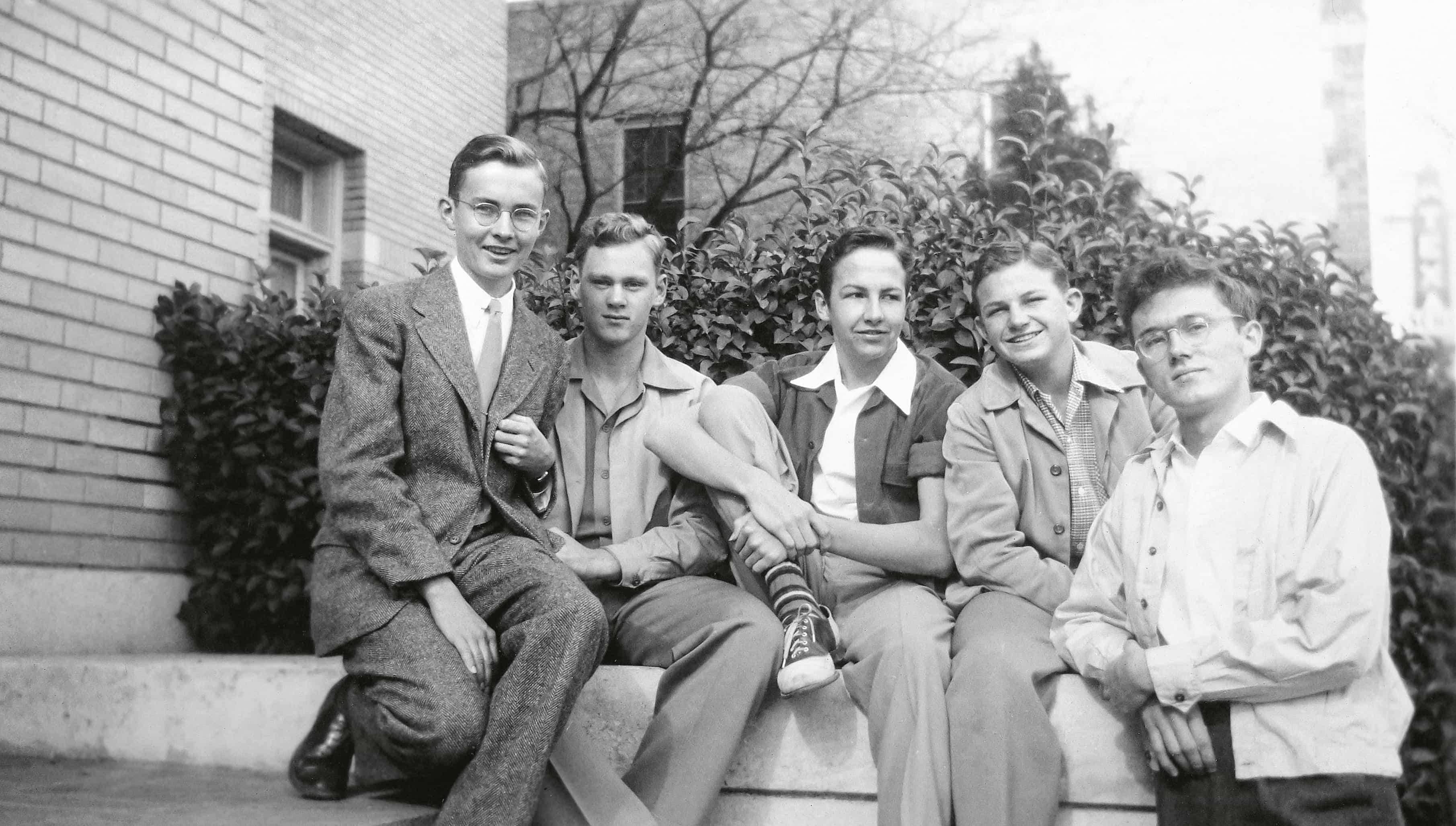
Fig. 3. Robert Rauschenberg (center), Arthur Frakes (far right), and three friends outside the YMCA, Austin, Texas, 1944
The massive mobilization effort required of the United States when it entered the war near the end of 1941 had prompted an intense debate about qualifications for military service. With an acute awareness of the shell shock suffered by soldiers in World War I, the medical establishment and the military initially attempted to be far more restrictive, eliminating men they assessed as vulnerable. For the first time, psychiatrists were included among the medical professionals who examined draftees. Despite such efforts, trauma among those who served was widespread during the war.26 The contemporary designation of “combat fatigue” indicates the aim to normalize the condition somewhat, representing it as transient, given time for rest and treatment. Training materials from the Navy, including journal articles, pamphlets, and films such as those Rauschenberg likely encountered, outlined an array of treatments, including talk therapy, hydrotherapy, hypnosis, and injections of sodium amytal, a drug with sedative and hypnotic properties. The aim was to return sailors to combat or, by the war’s end, make them suitable for a job in civilian life.27
This pragmatic orientation attempted to remove the stigma of mental breakdown. Training materials emphasized the normality of the afflicted service members, with the repeated refrain: Everyone has a breaking point.28 As compassionate as Rauschenberg’s attitude now appears, it was also an orientation likely fostered by the military and medical training he received. His tendency toward identification with his patients was underscored by the military’s evolving view of mental health and illness as a continuum, with the mean recognized as social normality. Moreover, the neuropsychiatric technician’s duties were often described in terms of vision: specifically, surveillance on behalf of doctors, who, as Rauschenberg recounted above, were assigned increasing numbers of patients and wards as the war came to an end. As the “go-between” for hospitalized sailors and their psychiatrists, Rauschenberg was responsible for keeping track of patients, interacting with them, trying to learn their histories, and observing them closely. As one Hospital Corps Quarterly training article explained, “This uninterrupted attention cannot be given by the medical officer who is limited in time. It is up to you who sees the patient around the clock.”29 The extent to which his training emphasized the observation of others may have informed Rauschenberg’s remark about his Navy service to Janis and Blesh in 1960: “You just can’t look at somebody [and] know all about their childhood, etc. Some of the most hideous things happen to people.”30
The lingering impact of Rauschenberg’s experiences in the Navy, especially the emphasis on visual scrutiny in his training, may have inflected aspects of his later identity as an artist. Once he entered the New York art world in the early 1950s, he became one of the most trenchant critics of Abstract Expressionism’s heated self-expressiveness: “The kind of talk you heard then in the art world was so hard to take. … It was all about suffering and self-expression and the State of Things. I just wasn’t interested in that.”31 More bluntly, he quipped, “You have to have time to feel sorry for yourself if you’re going to be a good Abstract Expressionist.”32
Rauschenberg’s impatience with some of the artists he encountered in New York takes on a different cast when considered in the context of his education about the human mind, his exposure to individuals who had suffered untold horrors, and his recognition that the way someone looks and what’s going on inside them may be two very different things. The appeal to authenticity and direct expression typical of the rhetoric around Abstract Expressionism could seem naive in the recollection of cases of profound trauma whose symptoms might appear contradictory—paralysis where no physical injury was apparent, for example—and whose resolution, in the form of social normality, could leave many avenues of existence unexplored. As Rauschenberg later reflected, “Actually I always liked the patients best just before they were completely cured—that area just before they become boring adjusted people, the period when they were curious, gentle, poetic.”33
Rauschenberg’s identification with his patients went beyond mere sympathy. Years later, he remarked, “I had such compassion for them. My troubles didn’t read as well as theirs did, but I guess if an analyst had written mine down, I would have been right on top.”34 Rauschenberg was just eighteen and far from worldly when he was drafted, and his comments may have referred to the general confusion that often accompanies growing up, whether in small-town Texas or a military hospital in wartime. Initially, the U.S. military’s interest in psychiatry was intended not only to reduce instances of mental breakdown in combat but also to detect and disqualify homosexuals during medical exams. Means of doing so ranged from simple questions (“Do you like girls?”) to the identification of presumably visible characteristics, such as effeminacy. After the United States joined the war in December 1941, however, the pressing need for more military forces meant that significant numbers of homosexual men were admitted, with the unspoken requirement that they keep their sexuality private. Once a soldier had been inducted, homosexuality was grounds for court-martial and dishonorable discharge—a judgment that could carry a jail sentence and make returning to civilian life much more difficult, as it was nearly impossible to get a job with such a record.35
Despite these dangers, there is ample evidence of same-sex liaisons and relationships in the U.S. military during World War II, but they existed along a wartime continuum of other types of connections and friendships.36 Just as every man had his breaking point, under the strains of combat physical acts of passion between two soldiers could be considered momentary lapses, as opposed to ineradicable proof of flawed character. Such acts occurred in the context of intense homosocial relations—close friendships between recruits were encouraged—and the terrors of combat and its aftereffects could foster emotional as well as physical intimacy. For the American writer James Lord, for example, the military was a place of sexual freedom and exploration, but it was also where two men could share a shattering moment of terror and comfort, as he recounted in his memoir My Queer War:
The night, however, was abruptly interrupted by someone shaking my shoulder. It was the man beside me, to whom I’d paid scant attention.
I said, “What the hell?”
“Sorry,” he whispered. “Could you just hold me for a minute? Please. Please.”
This was no sexual plea I realized instantly as he held out his arms and I helped him into mine and in the tangle of blankets I could feel him trembling. “What’s wrong?” I whispered. “Are you sick?”
“I’m so scared,” he said. “I’ll tell you. Please. Hold me as tight as you can. I’m so scared.”
“Okay. It’ll be all right.” And I did hold him as close as I could, felt him trembling against me, and a sound as of a sob came choking from him, and I’d never known what it was to hold a human being in my arms in the desperate throes of his humanity, not a quiver of the sexual sense in it, no.37
Rauschenberg’s correspondence and later remarks occasionally allude to the intimate proximity of male bodies. The sheer number of men expected to sleep in the same barracks was initially disconcerting: “I hated living in the dormitory. I’d never seen more than five or six persons together at once except in church, and it was just too different.”38 He soon adapted, and if he sometimes preferred solitude, he also often went on liberty with his fellow corpsmen, staying together at small boarding houses, hotels, and YMCA dormitories.39 His medical training further acquainted him with the male body; in San Diego, he had night duty that included providing education on venereal diseases and prophylaxis to sailors going on leave. He wrote to Frakes, “It’s very interesting work, sometimes disgusting though, I certainly hear some interesting tales as you can imagine.”40 During his time in the Navy, Rauschenberg encountered the male body in all its strength as well as its vulnerability—wracked by tuberculosis and spinal meningitis, devastated by unseen trauma, or worse. Rauschenberg later recalled that, at one point in Corona, “My job was to wrap corpses, to tie them off so that they didn’t make a mess in the bag, and give them one last bath—at the point where they’re most contagious!”41
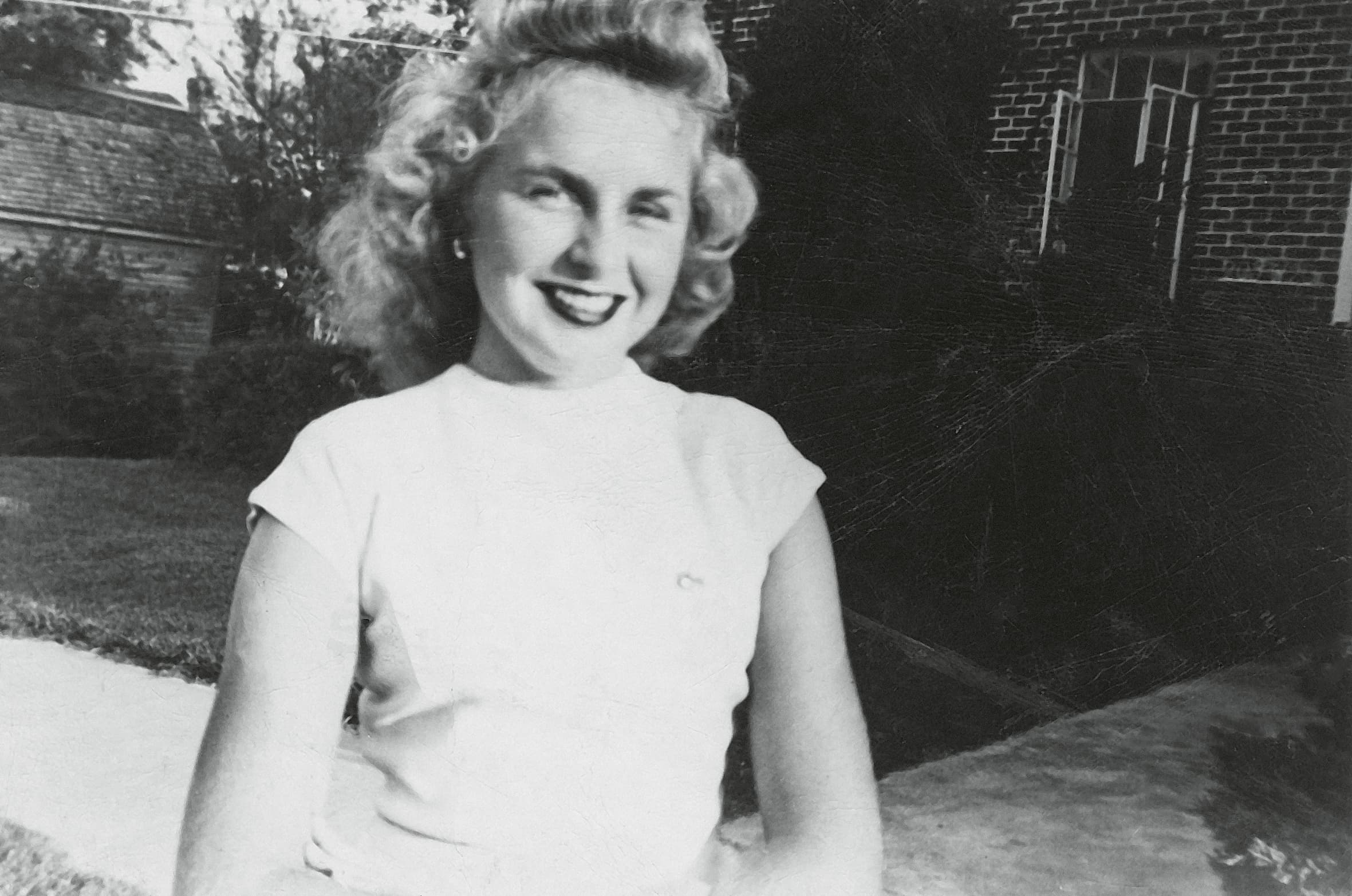
Fig. 4. Gay Braun, 1945
While the contents of Rauschenberg’s letters to Frakes provide important information about his experience in the Navy, including his friendships with other sailors, their existence, in turn, complicates our understanding of Rauschenberg as a young man. The artist’s near-complete refusal to discuss his sexual orientation throughout his life formed a paradoxical counterpart to an artistic life that was remarkably open in other respects. After his marriage to Susan Weil—which ended largely on account of his relationship with Cy Twombly—Rauschenberg’s habit of pursuing creative work with romantic partners meant that a series of men, including Twombly, Jasper Johns, the dancer and choreographer Steve Paxton, and others, were long known in the artist’s literature simply as “friends.”
A consideration of Rauschenberg’s letters to his high school friend, then, inevitably raises the question of how their relationship should be regarded. This was initially even more difficult to ascertain in the face of Rauschenberg’s reaction to Frakes’s decision to bequeath their correspondence to the Menil Archives at the Menil Collection, Houston: The artist had the letters sealed. When I contacted the Menil Archives about the Frakes letters in 2015, I was told that they were sealed because they were “personal in nature” and that they had been restricted at Rauschenberg’s request. In response to my query, the Robert Rauschenberg Foundation lifted the restriction in 2016, and I have been researching the collection’s contents since then.42
The exchange’s one-sidedness complicates matters further. Frakes’s archive holds a wealth of correspondence from Rauschenberg to Frakes—letters, postcards, greeting cards, and so on—while only three letters from Frakes to Rauschenberg, primarily relaying jokes and gossip about mutual friends, are known to have survived.43 Frakes’s archive also includes photographs of the two of them, often with other male friends, in Port Arthur and Austin (fig. 3), enjoying casual physical contact and even relaxing together on a bed.44 Yet if Rauschenberg’s letters to Frakes do not establish definitively whether the pair’s relationship went beyond platonic friendship, they do demonstrate that long before Rauschenberg entered the public eye or even considered becoming an artist, he was adept at presenting his identity and interests in different ways, depending on the audience. In letters to his parents, he told them about nurses he was dating, including an ensign at Arrowhead Springs who was interested in marriage, and he sent photographs to them as well. To Frakes, he mentioned one date with the same woman, only to offer reassurance: “I had a date with Miss Elder my nurse to go dancing to Harry James. Purely on the up and up and off the record. You know she’s an ensign of 23 and I’m an HA 1/c [Hospital Apprentice First Class] of 19. We have fun together though we go hiking, mountain climbing and horseback riding together. I don’t know what her intentions are, but mine are honorable.”45
Rauschenberg’s letters to Frakes are heartfelt, affectionate, playful, and sometimes flirtatious, but above all, they are the correspondence of a young man who presents himself as enjoying the company of women and men alike. In many of his letters, he obsesses, as any eighteen- or nineteen-year-old might, over his feelings for Gretchen Braun (1927–2013; fig. 4), known as Gay, a young woman from Port Arthur who was also friends with Frakes.46 While Rauschenberg worried in some letters whether Braun returned his affections and even whether he should buy her a ring, others offer lengthy descriptions of weekend leaves when he went dancing at the Palladium or the Hollywood Canteen in Los Angeles with a variety of young women; attended movies, plays, concerts, and live radio broadcasts; and, charmingly starstruck, introduced himself to movie stars entertaining the troops, sending Frakes autographs from Kay Francis and Gloria DeHaven, among others.47 In some letters, he offered assessments of their appearance: Ginger Rogers was “gorgeous”; DeHaven, “the most beautiful thing you have ever seen”; and Deanna Durbin, “awful not a bit pretty.”48 He gave special attention in his letters to Judy Garland: “You know how crazy about her I am. She was a little disappointing She didn’t have the ease that she should have possessed The only time she was really easy and graceful was when she sang, Gosh was she good!!”49
While Rauschenberg was later to stress his tendency to be a loner in the Navy (and, for that matter, in high school and college), his correspondence with Frakes reveals quite the opposite. In addition to accounts of dancing and encounters with celebrities, he also sizes up other sailors: “Jones is my best friend up here and he’s nice lookin’ and is 6'2" and from Dallas.”50 On weekend leaves, he goes out with some of them: “O.K., I know what you want to know, don’t I? Chuck is a very interesting person and, golly, what a build. He is only about 5'10", but he weighs 162 lbs. It’s all muscle, too. If he were only about 4" taller he would make a good Atlas ad.”51 Like his friendship with Frakes, his associations with his fellow sailors—mentioned in his letters as Jodie, Razzy, Harry, Soules, and Roger, among others—have rarely been noted in accounts of his early life, and it remains unknown whether his relationships with them encompassed physical affection. Rauschenberg likely knew better than to express things in letters, especially during wartime, that could have gotten him in trouble—a self-protective discretion that continued throughout his life.
Still, it’s striking how unguarded Rauschenberg’s letters can be. From basic training, for example, he teasingly reassured Frakes, who had not yet been called up for service, “Arthur you don’t have to worry about getting along with so many boys—you know what I mean.”52 Other letters make it clear how difficult it could be for young men to come to terms with emotions that were not supposed to be acknowledged, let alone discussed. Of his friendship with the sailor named Chuck, Rauschenberg wrote to Frakes,
I don’t know how to explain it, but Chuck and I just seemed to drift apart, much to my sorrow. I can’t remember doing anything to make him mad. We had big plans for this last weekend in L.A., but he went out with 2 other guys. I didn’t say anything to him about it. I guess he could tell I knew that something was wrong. I had to eat with him Monday in the dining room and he asked me what I had done I told him very briefly and just kept on eating. He told me what he had done and I said nothing, then right out of the blue sky after a few minutes of silence he said “Milton, I really missed you this weekend.” He told me how sorry he was about everything, but he couldn’t explain it, either. He told me all kinds of things such as he didn’t realize how much I meant to him until he quit running around with me.53
Overall, the trajectory of Rauschenberg’s letters to Frakes between 1943 and 1948 shows a rather unworldly young man quickly gaining knowledge and experience, growing in sometimes actual, sometimes affected, sophistication, and already displaying a disinclination to be bound by contemporary expectations around masculinity. These qualities would also feed into the creative pursuits that took root during these years.
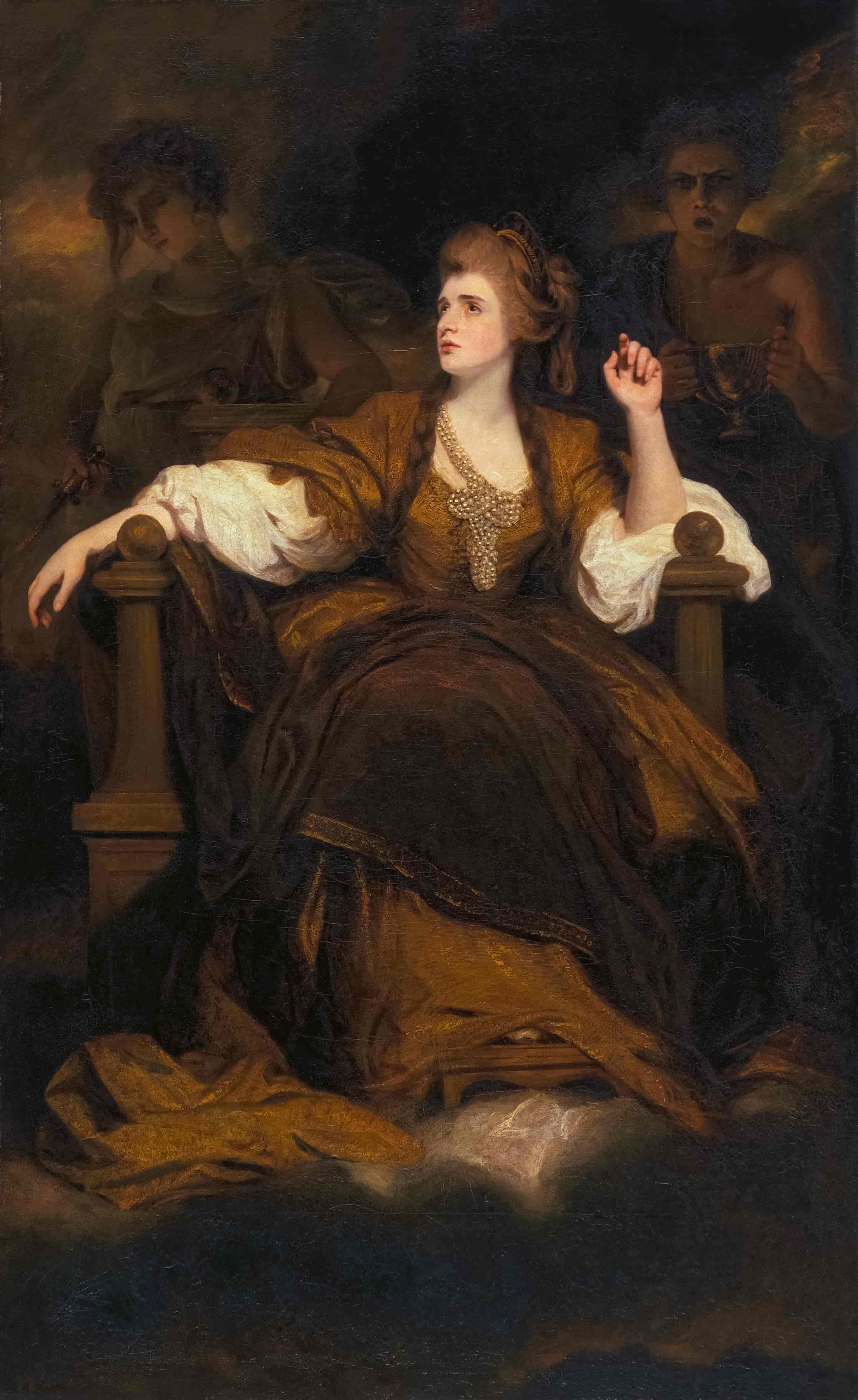
Fig. 5. Joshua Reynolds, Sarah (Kemble) Siddons as the Tragic Muse, 1783–84. Oil on canvas; 94¼ × 58⅛ in. (239.4 × 147.6 cm). The Huntington Library, Art Museum, and Botanical Gardens, San Marino, Calif.
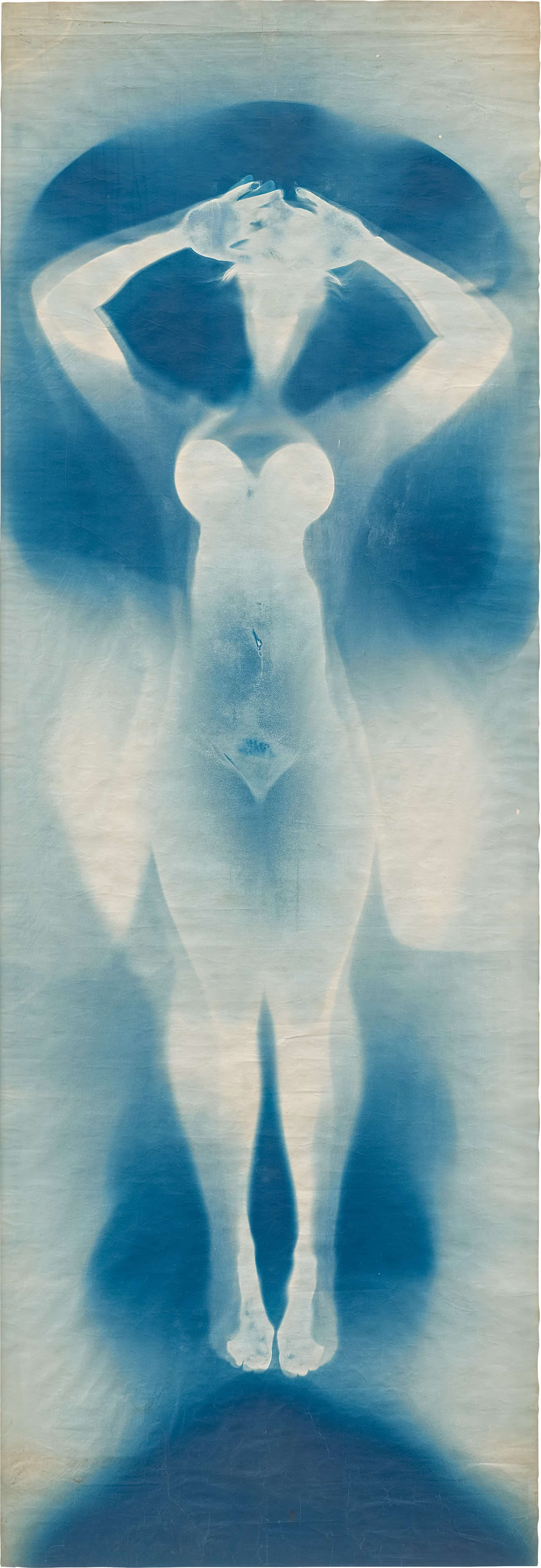
Fig. 6. Robert Rauschenberg and Susan Weil, Female Figure, ca. 1950. Cyanotype; 104⅝ × 35⅞ in. (265.7 × 91.1 cm). Robert Rauschenberg Foundation, New York
One event that goes unmentioned in Rauschenberg’s correspondence with Frakes is a weekend leave he took in 1946 while stationed in Oceanside, during which he visited the Henry E. Huntington Library and Art Gallery in San Marino, California. Initially, he was drawn there by the cactus garden on the grounds, one of the oldest and largest of its kind.54 He subsequently wandered into the large house, which had opened to the public as a museum in 1928, where he found Henry E. and Arabella Huntington’s art collection and its particularly strong holdings in eighteenth-century British portraiture. There, Rauschenberg had what he described as his “first encounter with art as art” in the guise of three monumental, full-length portraits: The Blue Boy (ca. 1770), by Thomas Gainsborough; Sarah Goodin Barrett Moulton, or Pinkie (1794), by Thomas Lawrence; and Sarah (Kemble) Siddons as the Tragic Muse (1783–84), by Joshua Reynolds (fig. 5).55 For Rauschenberg, it was an epiphany to learn that there were people who had “thought those things out and made them. Behind each of them was a man whose profession it was to make them.”56 As he later admitted, “It sounds really corny, but my moment of realization that there was such a thing as being an artist happened right then.”57
Like many stories of the flashes of enlightenment that initiate an artist’s trajectory, Rauschenberg’s encounter lends itself to a more complex constellation of meanings than might initially appear. The Blue Boy and Pinkie, in particular, were already familiar to him from their miniaturized reproductions on decks of playing cards: Part of his surprise at the Huntington was undoubtedly the jolt of confronting them at actual size, “with the integrity of real objects,” after having handled multiple reproductions that could fit in the palm of his hand.58 The difference in scale and relative uniqueness between actual artworks and their tiny doppelgängers would linger throughout Rauschenberg’s oeuvre in works that included the entire human body at one-to-one scale, such as the cyanotype Female Figure (fig. 6); the Combine Wager (1957–59); the lithograph Booster (1967); and panels 41 to 61 of The 1/4 Mile or 2 Furlong Piece (1981–98), a section called “Bob’s Army.”59 The experience resonates as well not only in the recurrence in his works of mechanically reproduced images of artworks but also—particularly in the silkscreen paintings and later series involving image transfers—in their repetition from one painting to another.
That The Blue Boy and Pinkie ended up on playing cards points to another remarkable convergence of cultural meanings that have been largely forgotten today (and, indeed, were likely unknown to Rauschenberg). If The Blue Boy is now so familiar as to verge on cliché, the roots of its notoriety lie in the years leading up to Rauschenberg’s visit to the Huntington. In 1921, Henry E. Huntington purchased The Blue Boy from a British collector for what was then the largest sum ever paid for a painting. Its sale prompted a national outcry in Great Britain, an exhibition at London’s National Gallery before the portrait was sent to its new home in the United States, and even a song by Cole Porter, “The Blue Boy Blues.” In 1927, Huntington acquired Pinkie, and while the two paintings had little in common beyond their format, the public often associated them with each other.60 The connection may have been sealed by the E. E. Fairchild Corporation, which paired the works sometime in the years that followed in a widely distributed two-deck set of playing cards (fig. 7)—perhaps the very set Rauschenberg had encountered.61
The renown of the two paintings and their association in popular culture had an unlikely secondary effect. The strict gender coding of pink for girls and blue for boys that became ubiquitous in postwar America was a relatively recent development. White was the typical color of babies’ garments in the nineteenth century, and pink, as a variant of red, was often upheld in the early twentieth century as a “masculine” color. The popularity of the Huntington paintings seems to have been a decisive factor in the subsequent shift. Thus, Rauschenberg’s visit coincided with a moment of flux in the associations of these two colors with particular genders and sexual identities—embodied, in The Blue Boy’s case, by a male sitter whose finery and long hair may have read as feminine to a contemporary viewer, even as his clothing’s color was becoming associated with masculinity.62
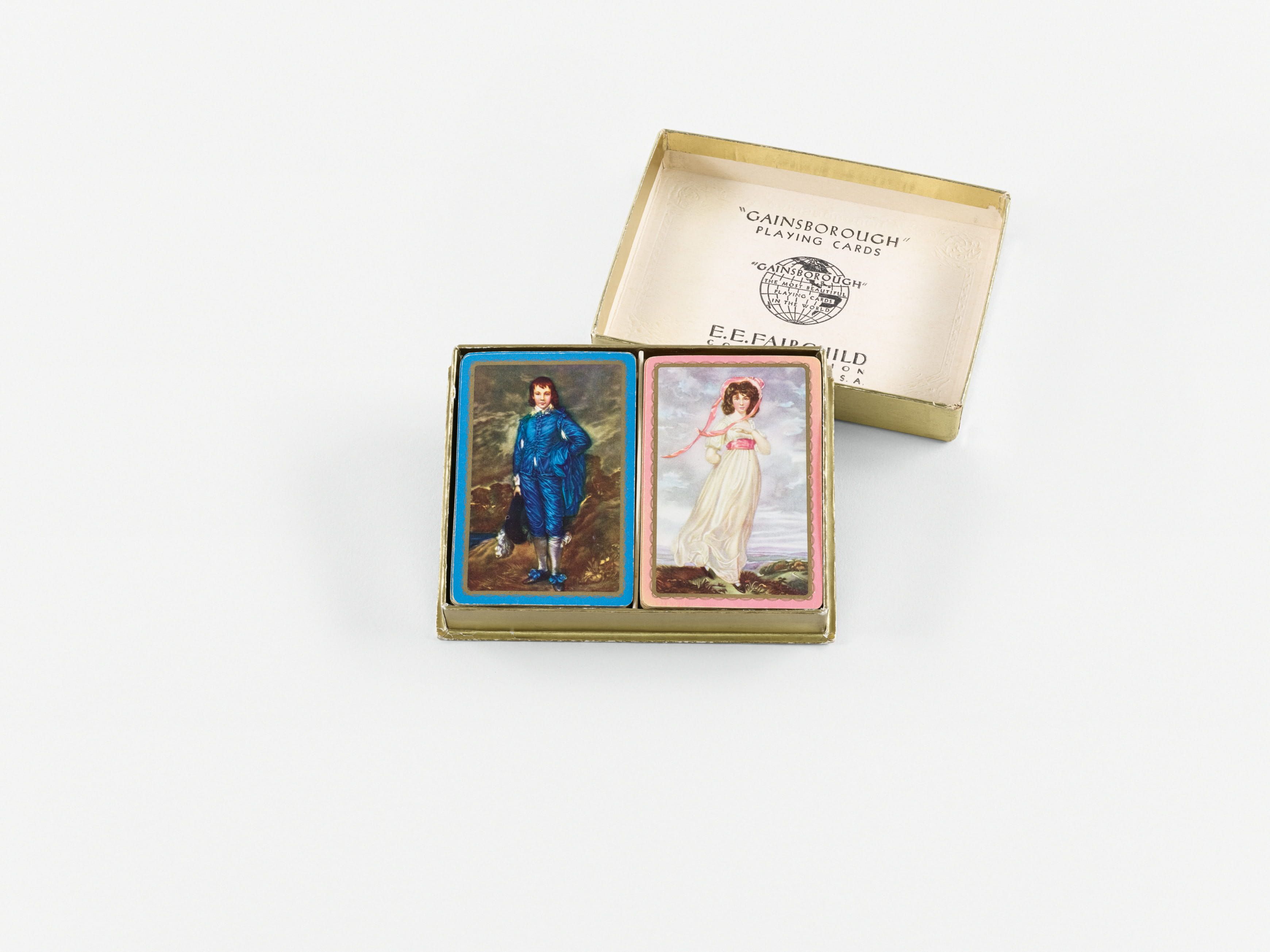
Fig. 7. Two-deck set of playing cards showing The Blue Boy and Pinkie, produced by the E. E. Fairchild Corporation, Rochester, N.Y.
Although Rauschenberg claimed to have no knowledge of fine art growing up, his letters suggest a thorough visual literacy in images of other kinds, especially in the realm of popular culture. He and Frakes decorated their room at the Austin YMCA with Saturday Evening Post newsstand posters, and Frakes commented in one letter to Rauschenberg on having found old issues of the men’s magazine Esquire containing images of “Petty Girls,” female pinups by the illustrator George Petty (1894–1975).63 In addition, Rauschenberg’s autographed photographs of celebrities were an aspect of his devotion to portrait photography and snapshots: Sending and receiving photographs was a constant theme of his correspondence with Frakes, especially after Rauschenberg entered the Navy. In one letter, he explained,
By the way, I’m really sorry about your not getting some of those pictures of me. I’m sure I have some more. I’ll try to figure out where they are and let you know. Arthur, when you leave [to enter the Army] be sure to take some pictures with you. You’d be surprised how much they help. I wish you would send me those pictures that I don’t have.64
As portraits, such photographs were descendants of the paintings Rauschenberg encountered at the Huntington—another reason those works may have made such a profound impression. It is also striking that he would be so enthusiastic in his appreciation of photographic images, given the role photography would eventually play in his career. Long before taking photography classes with Hazel-Frieda Larsen (later Archer; 1921–2001) at Black Mountain College, Rauschenberg wrote a grateful letter to his parents for an unexpected Christmas gift: “[It’s] so wonderful to have a camera of your own—you know how much I always wanted one.”65
As important as his visit to the Huntington was to Rauschenberg, the concept of actually becoming an artist took shape in his mind rather more gradually than the purported epiphany might suggest. Growing up, he had made drawings regularly, and his letters to Frakes frequently contained sketches, along with occasional references to painting.66 Knowledge of his talent had also spread beyond his friend: A girl from his high school inscribed the graduation photo she gave to him, “I’m going to have you draw ‘Rauschenberg Girls’ all over my house someday.”67 Once he was drafted into the Navy, his skills found a wider audience. En route to basic training, Rauschenberg wrote to Frakes, he had sketched a fellow passenger and “about fifty other people on the train, I was really a sensation—modest me—no, but people did think I was good.”68 He remained in demand, making portraits of his fellow sailors, although only two examples have so far come to light: a drawing of a seated sailor and a painted portrait of another (fig. 8).69 Each shows a likeness of a square-jawed, handsome young man that would not have been out of place in a magazine of the time. Whatever his skill and popularity, however, and unlike other aspiring artists, such as Ellsworth Kelly, who found postings keyed to their talents, Rauschenberg had no option for a different military assignment:
Mom you should see some of my latest drawings I like them a lot and everyone else raves about them. One of the officers was in this noon when we were supposed to be at chow and he looked at them and told me that he really liked them and that I should be in Visual Education (a branch of the navy that does posters and things) we both laughed because it is impossible to get out of the medical corps—not that I would.70
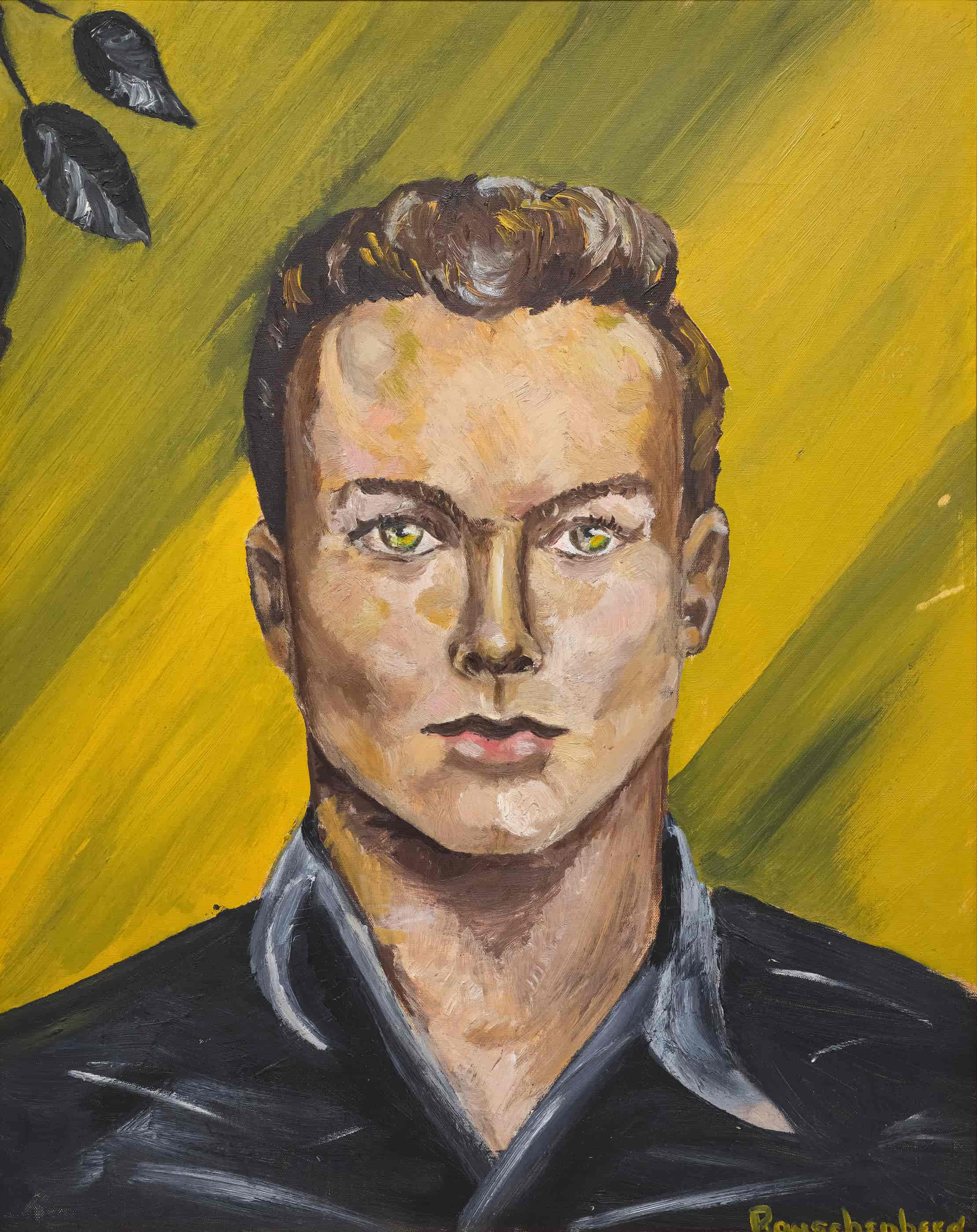
Fig. 8. Robert Rauschenberg, Robert Hubler, 1946. Oil on canvas; 20 × 16 in. (50.8 × 40.6 cm). Private collection
Rauschenberg’s gradual pursuit of art runs parallel to his coming of age in the Navy. He had gone to college largely to please his parents, and an early letter from his military service has him brightly asking them, “What have you all decided about my future?”71 In contrast, just a year later, with the end of the war in sight, he wrote, “What do you want me to do. Make my living in P.A. [Port Arthur] at one of the refineries like the rest of the P.A. boys. That’s not for me I’m going places.”72 Rauschenberg’s determination to forge his own path was aided by the 1944 Servicemen’s Readjustment Act, commonly known as the G.I. Bill, which, among other things, afforded tuition and living expenses to veterans for college-level education. The G.I. Bill supported Rauschenberg through his studies at the Kansas City Art Institute, Académie Julian in Paris, Black Mountain College in North Carolina, and the Art Students League of New York.
Surprisingly, prior to his epiphany at the Huntington, Rauschenberg had contemplated a different career path, one that he continued to pursue for several years afterward. During this period, his driving passion was costume and fashion design. Evidence of his fascination is hidden more or less in plain sight throughout accounts of his early life. In high school, for example, he was a costume designer for the school’s Repertoire Players.73 Correspondence with his parents and Frakes after entering the Navy indicates his increasing seriousness about pursuing this interest. One letter to Frakes outlines his dream of opening a shop together that would offer Rauschenberg’s creations:
Arthur are you going to go to France with me to study—you will I know. It sounds fantastic, but why not? Don’t even talk about the money; we’ll get it somehow. After studying [in] Paris we’ll come back to the States with all of the prestige that goes with one who does study abroad. We can go by way of England. Yes, I’m serious. Arthur we are going to have a glorious business. You are going to manage my shop. Our first place will be in Dallas after we get that set up we’ll open up another in New York. Of course I hope you are going to be a good enough manager, you will tell me how good the fiber of the material is and supervise all of our book work and figuring, advise me as to the quality of dyes—judge my work criticize my drawings—offer suggestions.74
This admittedly fanciful proposition is as unlikely as it is charming, but its underlying seriousness is echoed in Rauschenberg’s letters to his parents. Immediately after asking them “What have you all decided about my future?” in the letter quoted above, he continues, “I have decided that there is nothing for me except designing.”
The importance of fabric and clothing to his art has long been an established part of Rauschenberg studies, starting with his mother’s prowess in sewing the family’s clothes and continuing with the use of textiles in his Combines and other artworks and the costumes he designed for the dance companies of Merce Cunningham and other choreographers.75 But the depth and intensity of Rauschenberg’s interest had not been fully appreciated in the literature until the Frakes archive was opened to researchers in 2016. The archive includes a 1944 letter from an administrator at the University of Texas addressed to Rauschenberg, answering his query about returning to school after being discharged from the Navy:
I don’t think you would want to take a degree from the University which included a major in costume design, for the only degree we offer for that major [is] the B.S. in Home Economics. However, you could take basic courses in costume design, if you wouldn’t mind being in classes which were almost entirely feminine.76
Undeterred, Rauschenberg investigated other possibilities. Letters to his parents further confirm his seriousness. In one, after a long description of his duties at Arrowhead Springs, he reports, “I have been keeping up with my designing lately because I can’t afford to lose my touch. I get out of practice after I haven’t drawn in a long time.”77 His correspondence includes mentions of the latest issues of the women’s fashion magazines Harper’s Bazaar and Vogue, and he also tells his parents, “In my spare time lately I’ve been going to the library doing research work on the history of costume designing.”78 He freely offers fashion advice to his mother, making suggestions prior to the family’s visit to San Diego in July 1945:
Mom I enclosed a picture could you fix your hair like this? I don’t know why, but when I looked at this out of Harper’s Bazaar I couldn’t help but think of you. It would be just the thing for you. Why don’t you try. About a coat. You do need a light wool coat. Do you think you could find a pale solid pink wool and make yourself a topper it would really be ultra for out here.79
He likewise makes suggestions for his sister, Janet, writing about an upcoming piano recital,
Say Mom why can’t you use the drawing I sent you last time for Janet with the little apron front. You could make it out of cheap organdy white, please do it. It’s awfully cute let her carry a little nosegay of white flowers with ribbons hanging from it and she can sit it on the piano before she starts to play.80
While stationed in San Diego, he reported visiting the head of the women’s “fashion saloon” at the downtown department store Lion Clothing. She connected him to other women in the field, including “Mrs. Becker,” an instructor in costume design at the “State Vocational Guide School,” who “went wild over [his drawings] and said that they were better than anything on the market now.”81 Rauschenberg’s initiative seems not to have yielded concrete results; he learned that none of the clothing stores in San Diego made their own dresses, so there was no possibility of having his designs produced.82 Nevertheless, his willingness to pursue advice and his drive to cultivate professional opportunities foreshadow the bold visit he made to Betty Parsons Gallery in 1951 to ask the gallerist to evaluate his work, resulting in his first solo exhibition in New York.
While the drawings he showed to “Mrs. Becker” seem not to have survived, clothing—whether worn by female classmates in Port Arthur, dance partners, or movie stars—figures prominently in his correspondence with Frakes. Sometimes, he wrote out descriptions, as when, as part of his general enthusiasm for Hollywood, he reported on the costumes in movies he had seen:
I just got back from seeing “Billy Rose’s Diamond Horseshoe” for the third time. It is really good Arthur and five different people designed the costumes. It is almost equal to the series of “Hello, Frisco, Hello!” “Rosie O’Gradie,” etc.83
Other letters combine verbal and visual assessments, such as one written from Port Arthur when Rauschenberg was still in high school and Frakes was beginning his first semester at the University of Texas:
Then I took Gay home and went to see Molly—WOW!! you should see Molly’s dress, it was simply gorgeous. … It was aqua net—pretty color. 11 yrds in the skirt trimmed around the neck and on the skirt with plumes. They were aqua, too. She wore a pink camelia in her hair.84
Rauschenberg accompanied this description with small sketches of the dress. He often resorted in his correspondence to annotated drawings that indicate a fairly sophisticated knowledge of the construction of women’s garments. Frakes’s archive also contains several undated drawings of attractive young women—perhaps examples of “Rauschenberg Girls”—some of whom are attired in costumes, such as a majorette’s uniform, rather than everyday clothes. Most significant for our understanding of Rauschenberg’s early interest in fashion is the survival, thanks to Frakes, of “Gay Garbs,” a portfolio of Rauschenberg’s designs for Gay Braun, likely made in winter 1944–45. Rauschenberg was probably referring to this group of drawings when he wrote to his parents in January 1945,
I sent Gay about 20 sheets of designs yesterday. The way I’m doing them now is really neat. I make them large and never put more than 1 or 2 on a page. I’m using regular water color paper and those pencils you sent me are wonderful—after I splash on the water colors I use the pencils to put in fine lines and details.85
Housed in a chipboard portfolio labeled “Gay Garbs / by Rauschenberg / Mgr. A. W. Frakes / Dallas, New York, San Francisco,” the drawings show women dressed in both day and evening wear.86 On the verso of each sheet, Rauschenberg provided a brief, handwritten description noting mood, fabric, and accessories:
Gold lamé on white silk or rayon—pointed effect on hips are furnished by protruding pockets. —may be made into street dress by doing away with pockets and shortening of skirt.
Black lady—Black satin and fuchsia / plain yet smart white or light green very fresh—
Black! Satin and Lace with bustle effect a double stran’ pearl choker should be worn / Green velvet with white satin bag.87
Some of the dresses take the form of full-skirted gowns, which seem to have been popular with young women of Rauschenberg’s acquaintance in Port Arthur and Austin, and Rauschenberg seems to have enjoyed sketching designs for them as well.88 Other dresses appear to be in close dialogue with current fashions and feature slim, inverted-V silhouettes, small bustles, collarless jackets, and removable pockets or sleeves. Many drawings incorporate vibrant color, with striking contrasts of hue: orange and vermilion, yellow on yellow, shades of pink and lavender.
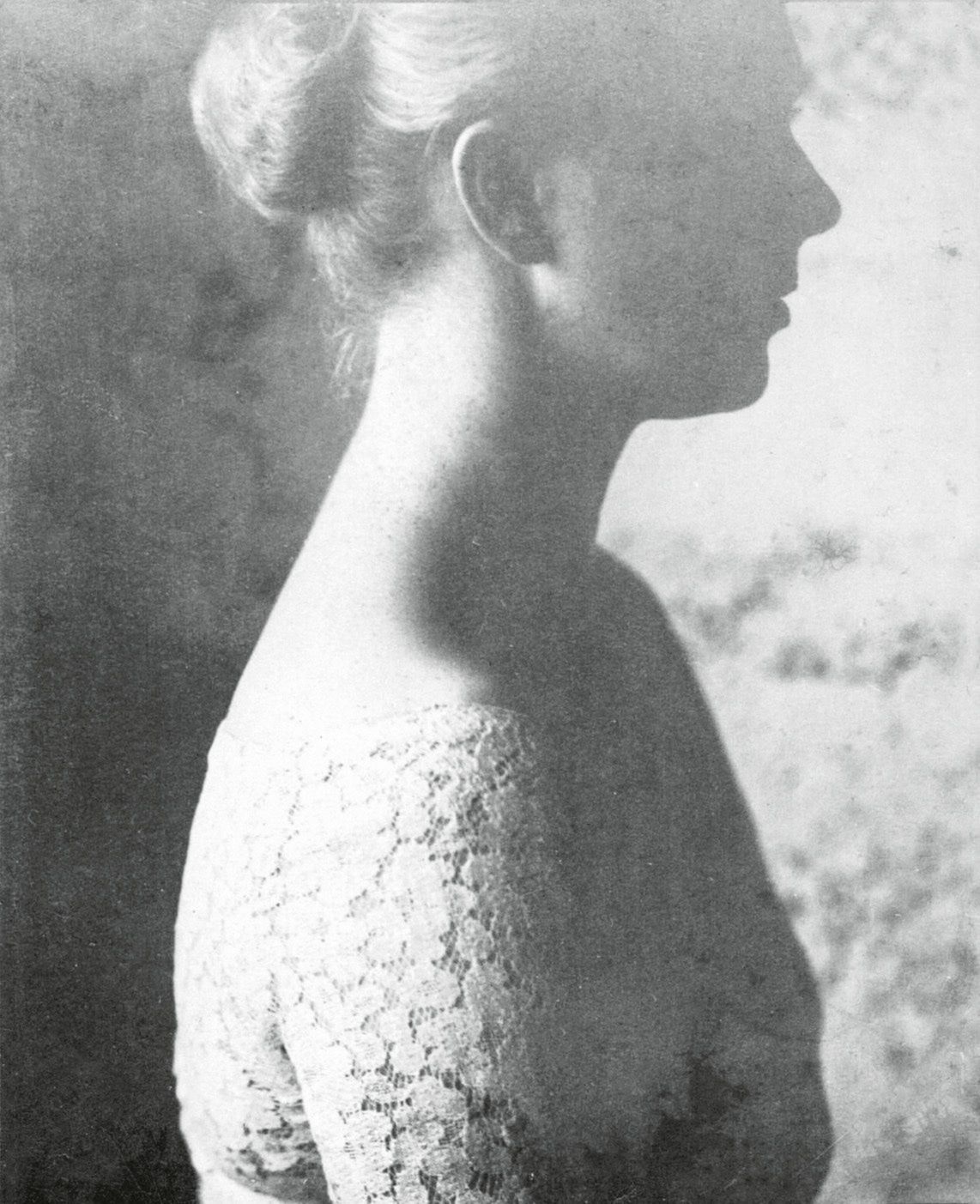
Fig. 9. Pat Pearman, Black Mountain, N.C., 1949
After his discharge from the Navy and following a visit to Port Arthur, Rauschenberg returned to Los Angeles, possibly motivated by perceived design opportunities. From Port Arthur, he wrote exuberantly to Frakes,
Did you know that I’ve made arrangements to sell my designs to a newly opening exclusive dress saloon [sic] in Los A[ngeles]. Brett and Co. I know Brett. I’ll go to UCLA if they’ll have me. I’m just waiting to hear from them at any day now. (wish me Luck.) I hope I can get in. It has a lot higher social standard and glamour (that’s French for $ money) connected to it than USC. … [I] thumbed through latest Vogue + H.B. [Harper’s Bazaar] left feeling as if I had just conquered the world, knowing that I can keep up with anything I’d seen. … Really Arthur I’m really very flattered at this chance I have for you see my designs will go into direct competition with Adrian’s. What higher compliment could I ask. I’m almost afraid to believe it. I guess there has to be a beginning somewhere so let’s hope that this bottom rung is a strong one.89
Rauschenberg’s mention of Adrian hints at a wider context for his ambitions. The fall of France to Nazi Germany in 1940 had cut off access to the previously dominant world of Parisian fashion, creating opportunities for American designers analogous to those made available to American artists during the war. A key figure in this regard was Adrian Adolph Greenburg (1903–1959), known professionally simply as Adrian. As Metro-Goldwyn-Mayer’s chief designer for over a decade, he had created dazzling, fantastic garments as well as dresses that influenced contemporary fashion. Sensing both a change of direction at the studio and an opportunity, he left MGM in 1941 and opened his own shop in Beverly Hills, selling original garments to the stars and, eventually, ready-to-wear clothing in exclusive arrangements with high-end department stores across the country. In the mid-1940s, the pages of Vogue were full of advertisements for Adrian’s clothes.90
In addition to blurring the boundaries between costume design and high fashion, Adrian played a central role in the creation of the period’s characteristic silhouette, with square shoulders and a slim, tailored line, as well as some of its more distinctive flourishes, such as bustles, dolman sleeves, and vivid color contrasts. Rauschenberg’s “Gay Garbs” portfolio presented its streamlined dresses (labeled “English silhouette,” “Grecian silhouette,” and “Chinese silhouette”) in a way that resembled then-current Adrian magazine ads: Each model is set in a seemingly vast space defined by a distant horizon and populated by one or two details defining the theme.91
After returning to Los Angeles in fall 1946, Rauschenberg worked briefly at the shop known as Original by Brett but quit when he saw no chance for advancement, let alone for getting his own designs made.92 His luck changed when he took a job packing swimsuits designed by Louella Ballerino (1900–1978) for the swimwear manufacturer Jantzen.93 One of a number of female designers gaining prominence during and just after the war, Ballerino focused on what would soon be referred to as women’s sportswear. Rauschenberg’s packing job was not particularly inspiring, but it introduced him to Ballerino’s personal assistant and secretary, Pat Pearman (fig. 9).
Born in Brunswick, Missouri, Pearman had studied fashion design and illustration at the Edna Marie Dunn School of Fashion in Kansas City. Edna Marie Dunn (1893–1983) was one of several women prominent in American fashion who were based in the city.94 By the 1940s, Kansas City had established itself as a fashion center, with numerous manufacturers, designers, and shops, in addition to the Kansas City Art Institute (KCAI), which was known for fashion design as well as fine arts. Before moving to Los Angeles, Pearman had worked as the personal assistant and secretary to the director of design at Donnelly Garment Company, home of the fashion label Nelly Don, founded by Nell Donnelly Reed (1899–1991). Reed was a fixture of the U.S. fashion industry, an influential figure in Kansas City, and, later, a member of KCAI’s board.
Pearman was three years older than Rauschenberg, but they quickly became good friends.95 Her family still owns his watercolor study Les Follies, which shows a theater’s “Entrée de Actuers [sic]” flanked by loosely sketched images of posters and washed in shades of violet and blue. According to the account passed down through her family, Rauschenberg had entered the sketch in some kind of competition in Los Angeles. Although he did not win, Pearman’s encouragement prompted him to give the drawing to her.96 Rauschenberg later credited Pearman with helping him take “what she called ‘[his] talent’ seriously.”97 KCAI would be a first step in making that happen. When Pearman returned to Missouri to help her ailing mother and resumed working at Nelly Don, Rauschenberg moved there as well.98 Events proceeded at lightning speed: Rauschenberg and Pearman met in early December 1946, and by February 1947 he was living in Kansas City, taking classes at KCAI. With her connections to Reed and the fashion community of Kansas City, Pearman likely helped expedite his admission.99
Rauschenberg was thrilled with his decision to attend KCAI, writing to his parents, “Oh golly I like it. It’s what I’ve always wanted.”100 Although he took classes in painting and sculpture as part of his curricular requirements, his focus was on fashion design. Likewise, much of his part-time work—decorating shop windows, creating sets for fashion shows, designing hats—involved design in one way or another and may have come about, at least in part, through Pearman’s influence.101 Rauschenberg later claimed to have learned more from his work than from his studies in Kansas City: “I got more out of those odd jobs—they were all jobs that I alone was responsible for, and they taught me a lot.”102
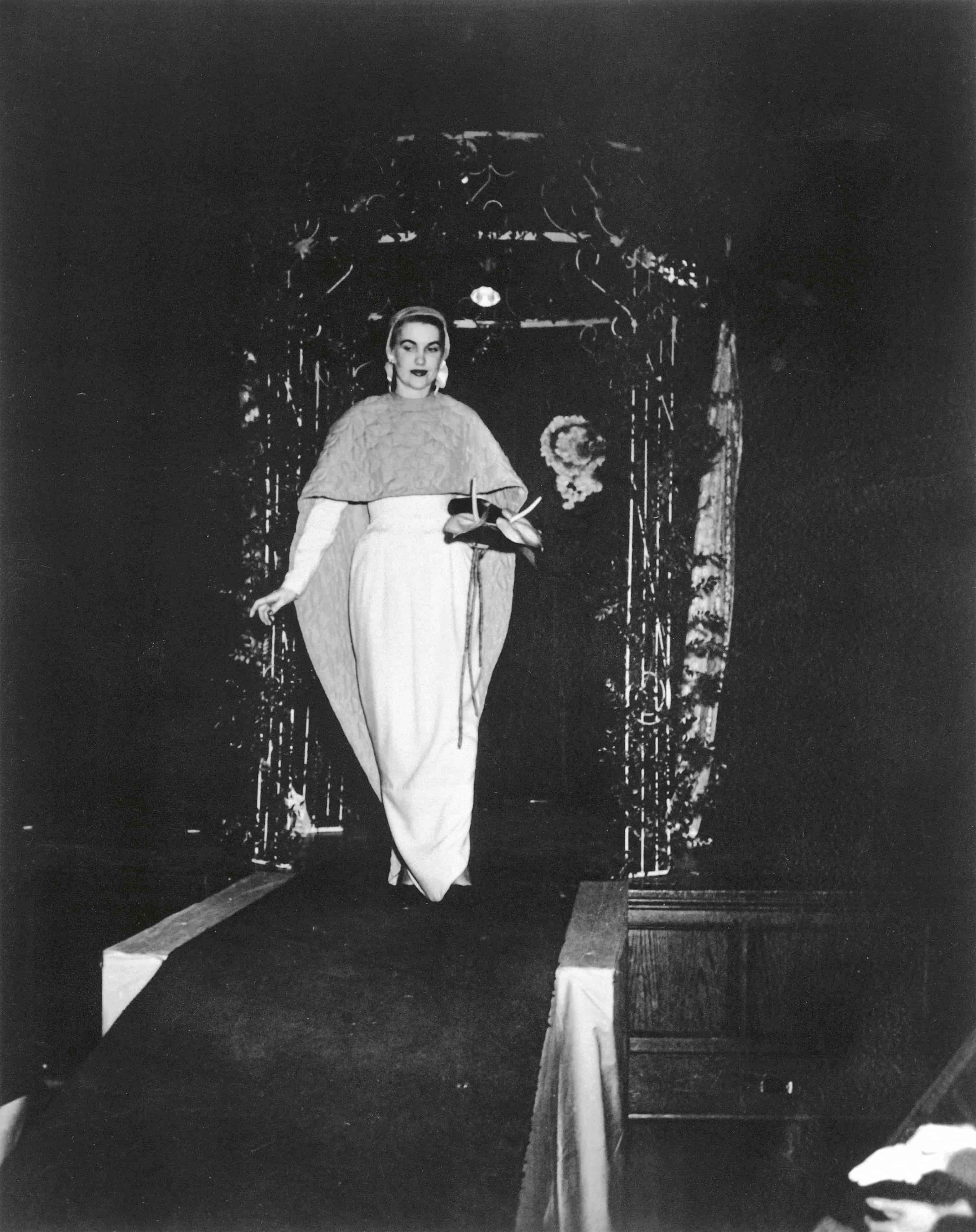
Fig. 10. Anthurium gown designed by Robert Rauschenberg, in quilted coral silk shantung over yellow jersey, Kansas City, Mo., 1947
Traces of Rauschenberg’s activities nevertheless attest to the richness and range of his student experience. For the city’s 1948 Spring Flower Festival, he was one of ten students selected to design costumes inspired by flowers.103 One of his dresses, in quilted coral-colored silk shantung over yellow jersey (fig. 10), was based on the anthurium and featured a hobble skirt to approximate the flower’s silhouette. More ambitious, perhaps, was his other contribution. Described in the Kansas City Times as the “showpiece among the costumes,” the design featured a clever inversion: The wide-skirted, green-striped dress was partially obscured by Rauschenberg’s placement of the hoopskirt’s architecture on the outside, forming a trellis for strands of ivy.104 On a less fanciful note, one of his final school projects, designed for the school’s annual outdoor fashion show, was an elegantly simple woman’s suit, for which he won second place in the suit category.105
Rauschenberg collaborated with his fellow students on other projects, including painting backdrops with French village scenes for a street fair benefiting the Kansas City chapter of American Aid to France.106 Pearman also preserved six sketches of nude figures, signed by Rauschenberg, that he may have made in connection with his art classes (see Chronology, fig. 7). He mentions life drawing classes in a letter to his parents, although a few of the drawings seem to refer to the work of other artists, such as a reclining nude seen from behind whose turbaned form and curvaceous proportions resemble those of an odalisque by Jean Auguste Dominique Ingres.107 Most striking is a drawing of a naked man whose handsome, chiseled face and level gaze share a kinship with Rauschenberg’s earlier portraits of sailors but whose muscular body is flayed, turning it into an anatomical study.108 This drawing may be related to the anatomy class he took with William Wallace Rosenbauer (1900–1968), an artist who was his teacher not just for anatomy but for sculpture and art history.109 As Rauschenberg later recalled, Rosenbauer “asked personally if he could keep my anatomy notebook, which I got an A+ [on] and he said that it would have been more if there was another way of grading it.”110 Although the focus was different, Rauschenberg may have benefited from his prior study of anatomy in the Navy.
Rauschenberg also painted a portrait of Pearman on a large, tripartite folding screen that he presented to her as a gift (1). Stylized but readily recognizable, Pearman gazes directly at the viewer, a rose-bedecked hat perched atop her head. Clutching a slim purse, or perhaps a book, she sits on a divan that is largely obscured by the voluminous, pale blue skirt of her strapless dress. At the left, nearly abstract passages of vivid blue and green suggest a sweep of drapery. In its monumental simplicity, if not its palette, the screen is Rauschenberg’s first known attempt to approach the scale of Reynolds’s portrait of Sarah Siddons at the Huntington and his first foray into the multipanel compositional format that would define so many of his later works.
At the end of May 1948, Rauschenberg left Kansas City on a train bound for New York, where, on June 2, he would board a ship to Paris. With his departure, he also seems to have left behind his desire to become a fashion designer. Instead, he had written to Académie Julian and was preparing to study painting.111 One wonders what happened. Had he also sought out fashion schools in Paris but not been admitted? Or did something push him definitively from one path to the other?112 Fashion had undoubtedly changed by spring 1948: Launched the year before, Christian Dior’s New Look, with its cinched waist, padded hips, and extravagant use of fabric, had signaled a profound cultural shift, with a stronger emphasis on traditional feminine characteristics.113
There is no indication that Rauschenberg studied fashion while he was in Paris. He quickly became friends with Susan Weil (b. 1930), who lived at his pensione, also attended classes at Académie Julian, and sketched with him at the Académie de la Grande Chaumière. She encouraged him to apply to Black Mountain College, which she was planning to attend in the fall. In Weil, Rauschenberg met a kindred soul who was already deeply engaged in the world of art, echoing the role Pearman had played for his interest in fashion. While his abandonment of fashion design in favor of fine art seems abrupt, the distinction was perhaps less dramatic at the time than it would subsequently appear. Art was regularly showcased in the fashion magazines Rauschenberg read, whether in feature articles or as props and backgrounds for models.114 Moreover, as Weil later recalled, Rauschenberg’s conversion—initially, at least—did not appear definitive: “Bob was not all that sure about painting. Of course he had all that vitality and intelligence, but he was trying to figure out whether painting was really for him.”115
In Rauschenberg’s application to Black Mountain College, painting and sculpture appear on his list of recent activities, but not fashion or costume design—although most of his letters of recommendation reflect his experience in the latter areas.116 Weil later recalled that in Paris, Rauschenberg used curtains from the pensione to create a gown for a fellow resident to wear to the opera. To accompany it, he made a special shawl:
He took a bedspread right off the bed in the pension—a taupe-caramel colored velveteen—went to the Galeries Lafayette to buy satin ribbon, stretched the ribbon across the floor, and stitched fresh ivy from the Bois de Boulogne to the ribbon. … Bob made a lattice with the ribbons and the ivy, and sewed it to the bedspread—it was her stole.117
For this design, Rauschenberg may have called upon the recent memory of the trellis-and-ivy dress he had designed in Kansas City. Otherwise, there is little evidence that his ambitions in fashion continued, although his engagement with design and clothing lingered in intermittent projects over the next several years.118 He brought with him to Black Mountain a sewing machine that he let other students use; he made a white-on-white weaving for Anni Albers’s textile class; and he designed a dress for his fellow student Ingeborg Svarc, known as Inga, which included a skirt with a corseted, dropped waist and a bolero jacket in gray, paired with a satiny blouse of olive green.119 When Weil became pregnant with their son, Christopher, Rauschenberg made her a voluminous maternity dress and took photographs of her wearing it (fig. 11). After Christopher’s birth, Rauschenberg made an outfit for him as well, which Weil described as incorporating whistles and “pockets with things in them for him.”120
Once we begin thinking about Rauschenberg’s interest in costume and fashion design as something that closely rivaled, and likely preceded, his ambitions as an artist, we gain a new understanding of his development and of the impact that interest may have had on the kind of artist he would eventually become. It is noteworthy that, on his 1946 visit to the Huntington, he was confronted with bodies portrayed at full length (which would become a focus of his work) and bedecked in outrageous and magnificent clothing. In The Blue Boy, in particular, that finery was created with emphatic, visceral brushwork and swaths of paint: Rauschenberg’s attraction to the portrait may have been as much a matter of how Gainsborough had painted as of what.121 Likewise, one of the defining material and conceptual characteristics of Rauschenberg’s art is a predilection for veiling and unveiling, whether with translucent or transparent layers of fabric or through the mechanics of image transfer.122 Yet discussions of this inclination rarely mention the renewed prominence of veils in films and fashion of the late 1930s and ’40s. A prominent element of many women’s hats at the time, the veil obscured the face, holding the personal at bay even as, in the words of one spread in Vogue, it also pulled “hat and head together into a close, neat unity.”123
If Rauschenberg’s early involvement with fabric, costume, and fashion became less visible in his biography as time went on, it continued to deeply inform his thoughts on art, especially on a conceptual level. He acknowledged as much in a 1966 panel discussion:
I never was convinced of the divine space of the canvas. I always recognize any canvas as a piece of cloth. It is just through the economy of lumber and structure that a fabric is woven horizontally and vertically and that it stretches most expediently in those directions.124
Rauschenberg also famously declared in 1959 that a “pair of socks is no less suitable to make a painting with than wood, nails, turpentine, oil and fabric.”125 It is now commonly understood that this subversive proposition opened up the possibilities of what materials could constitute a work of art. But Rauschenberg’s radicalism may actually have rested in his recognition that the instrument of subversion was already there: in wood, nails, turpentine, and oil, but especially in fabric, whether a pair of socks or an expanse of bare canvas.
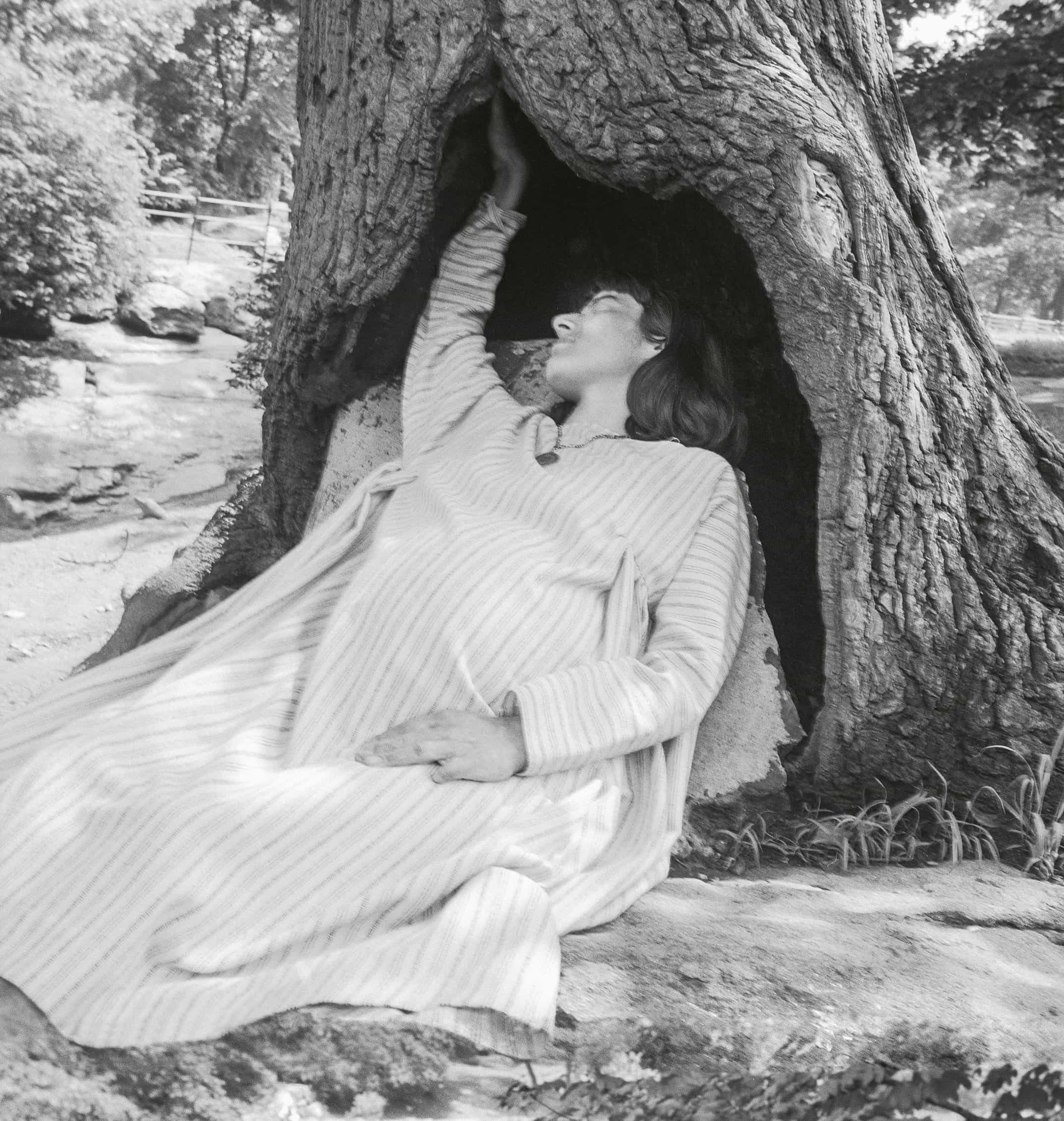
Fig. 11. Susan Weil in Central Park, New York, 1951. Photograph by Robert Rauschenberg
When Rauschenberg went to Paris, he made plans to send his paintings back to Pearman for her to see before forwarding them to his parents.126 Perhaps at his urging, Pearman went to Black Mountain College in June 1949 and worked as a secretary there.127 Their friendship remained close into the early 1950s: Pearman attended Rauschenberg and Weil’s wedding in 1950 and posed around that time for their cyanotype Female Figure.128
Rauschenberg likewise invited Frakes to his nuptials, even sending him a telegram entreating him to attend.129 Frakes seems not to have done so; the last letter in Frakes’s archive is postmarked ten days before Rauschenberg’s departure for Paris, a trip he had once proposed to Frakes that they take together:
For you to say naturally “I won’t have anything to say in this letter” and then to write such a masterpiece of unselfish friendship. For the first time, Arthur, after reading your letter I did not want to go. I at this moment have the strangest feeling of hesitancy of something almost fatal in my going. It may have been that I was so touched by the purity of our friendship and the depth of your feeling. Arthur I would feel wonderful if you would just even hint of there being a possibility of your joining me later. Arthur, wire me when you receive this—For what I don’t know, but at this moment I feel an extreme need to hear from you—OK?130
Gaps in the historical record occur for a variety of reasons. Pearman’s move back to Missouri in 1951, her assumption of her husband’s name upon her marriage in 1953, and her untimely death in 1978 have all contributed to her relatively diminished presence in considerations of Rauschenberg’s early years. For his part, Frakes stayed in Texas, never married, and remained in sporadic contact with Rauschenberg over the years, collecting gallery announcements and other ephemera and seeing the artist when he returned to Texas for various events.131 Their friendship, along with Rauschenberg’s connections to a range of male friends in high school, college, and the Navy, has been absent from accounts of his early life.
When her son’s art class planned a visit to New York City in 1974, Pat Ludington used the opportunity to get back in touch with her old friend. She wrote the letter quoted at the beginning of this essay just after the telephone call that initiated their reconnection.132 Over the next eighteen months, Rauschenberg was constantly busy with new projects as well as with his 1976 retrospective at the National Collection of Fine Arts in Washington, D.C., with its attendant questions about all phases of his life and career—an apt period for him to consider Ludington’s query, “I am wondering many things about you, how you feel about your life, whether you have realized and attained as you had wished, any regrets—or whether you ever allow yourself the luxury of looking back?” Shortly before the retrospective opened, Rauschenberg sent her a postcard that contains, perhaps, an inadvertent response:
Want to say hello + ask a favor. All kinds of terrible works of mine are showing up as money + threats. Not suggesting a possibility of either with you and your lovely family but would you please tear up that awful Les Follies for me I’ll give you something else.133
Les Follies survived—it had already been framed by the family. Instead, two other works were destroyed, although it is unknown whether this was at Rauschenberg’s request.134
Ludington’s extended question to her old friend—“are [we] the sum total of every single moment of our lives … or have there been lots of moments and hours which could have just as well been left out”—is at the heart of my attempt to reconstruct a more historically accurate account of Rauschenberg’s early years.135 The artist shaped his identity in the tension of these two possibilities, and in this regard, his request to Ludington is not surprising: Artists often destroy work, especially their early efforts. In Rauschenberg’s case, his attempt to suppress Les Follies may speak to his need to preserve an artistic identity that was years in the making, one that might be described as an act of self-invention inseparable from the art he had made. As he explained to Calvin Tomkins, “I tend to like things that are not supported by historical fact. To this day, that’s the element I find most fulfilling in my work.”136 When the artist’s death in 2008 brought his body of work to a close, a different story could begin to emerge—one that no longer had to depend on Rauschenberg’s efforts to shape it into the life of the artist he wanted to be. While the results may not possess the arc of a carefully spun narrative—or that of a tall tale—the glimpses they offer of a young man finding his way to art nonetheless provide a compelling, and complicated, portrait.
Author’s Note: In 2022, at the invitation of Helen Harrison, I gave the first public presentation of this material in a talk at the Pollock-Krasner House and Study Center, East Hampton, N.Y. The following year, the Robert Rauschenberg Foundation invited me to write on the topic for the first volume of the artist’s catalogue raisonné, and I completed the initial version of this essay in January 2024. I have been aided inestimably in my work by many individuals and institutions. Katie Robinson Edwards and Mark L. Smith offered their memories of Arthur Frakes, and Link Ludington generously shared recollections, memorabilia, and artwork related to Rauschenberg’s friendship with his mother, Pat Pearman Ludington. Geraldine Aramanda and her successor, Lisa Barkley, at the Menil Archives, The Menil Collection, Houston, hosted my first and all my subsequent viewings of the Frakes correspondence and ephemera over the past decade. Early on, André B. Sobocinski provided important assistance with U.S. Navy medical history. I am extremely grateful to the Robert Rauschenberg Foundation and its staff, including Julia Blaut, Gina Guy, Helen Hsu, Francine Snyder and the Robert Rauschenberg Foundation Archives staff, and David White, along with Eric Banks, Susan Davidson, Jackie Foster, Talia Shiroma, and the contributing authors to the Rauschenberg catalogue raisonné project. I also appreciate the support and encouragement of my colleagues at the Nasher Sculpture Center, Dallas. Lastly, Lewis Kachur has been a knowledgeable and patient reader, and so much more.
Pat Pearman Ludington to Rauschenberg, April 28, 1974, Ludington Family Collection. The letter (which survives only as a carbon copy; it is unknown whether it was sent or received) is dated “Sunday afternoon, April 29?, 1974.” The question mark is in the original; April 29 fell on a Monday in 1974.
Reference copies of Rauschenberg’s U.S. Navy records, of his Black Mountain College application and course cards, and of the letters to his parents in the Rauschenberg Family Collection are held in the RRF Archives.
⤴Frakes was born in Missouri in 1925 and moved with his parents to Port Arthur before he turned five in 1930, when the U.S. Census shows them already settled there. It is not known whether he and Rauschenberg were acquainted before high school, but correspondence suggests that their mothers were also friends.
⤴Pat Pearman married Harley Ludington in 1953 and assumed his surname. I use “Pearman” to refer to her prior to their marriage and “Ludington” in later references, such as the letter quoted in the epigraph.
⤴Calvin Tomkins, “Profiles: Moving Out,” New Yorker 40, no. 2 (Feb. 29, 1964), pp. 39–105. Robert Rauschenberg, organized by Alan Solomon, the director of the Jewish Museum, New York, was on view from March 31 to May 12, 1963. For the Biennale prize, see Introduction (n .1).
⤴Rauschenberg described himself to the critic Barbara Rose as “definitely antisocial” when he was growing up, claiming that “in those days I wasn’t even asked to parties.” Quoted in Barbara Rose, Rauschenberg (New York: Vintage Books, 1987), p. 12.
⤴Rauschenberg to Arthur Frakes, June 26, 1946, FS 174, Frakes Estate, Menil Archives.
⤴Rauschenberg, quoted in Wendy Lin, “The Boy from Port Arthur,” Art and Antiques, Feb. 1986, p. 60.
⤴Catherine Craft, An Audience of Artists: Dada, Neo-Dada, and the Emergence of Abstract Expressionism (Chicago: University of Chicago Press, 2012).
⤴Scholars often consider the context of World War II in the study of Abstract Expressionism, even though none of that movement’s best-known practitioners, such as Willem de Kooning, Robert Motherwell, Jackson Pollock, and Mark Rothko, served in the military. Military service was, by contrast, common among artists of Rauschenberg’s generation, including Jasper Johns, Ellsworth Kelly, Edward Kienholz, Roy Lichtenstein, and Cy Twombly.
⤴Rauschenberg to Arthur Frakes, postmarked March 8, 1943, FS 145, Frakes Estate, Menil Archives.
⤴“Medical History,” military record of Milton Ernest [Robert] Rauschenberg, National Archives and Records Administration. Reference copy held in RRF Archives.
⤴Rauschenberg to Arthur Frakes, postmarked Feb. 2, 1944, FS 152, Frakes Estate, Menil Archives.
⤴André B. Sobocinski, Deputy Historian and Publications Manager, Office of Medical History, Navy Medicine Institute for the Medical Humanities, to the author, email, Feb. 7, 2011.
⤴Regarding his family’s history of tuberculosis, see Rose, Rauschenberg, pp. 16–17.
⤴“Combat fatigue,” also known as “battle fatigue” or “combat stress reaction,” replaced the World War I–era term “shell shock” during World War II. For a use of the term “combat fatigue” Rauschenberg may have encountered during active duty, see Kenneth C. Werner, “NP Rehabilitation,” Hospital Corps Quarterly 18, no. 9 (Sept. 1945), p. 35.
⤴Rauschenberg, quoted in Rose, Rauschenberg, p. 15.
⤴Rauschenberg to Arthur Frakes, postmarked June 10, 1944, FS 161, Frakes Estate, Menil Archives.
⤴Rauschenberg to Arthur Frakes, postmarked Aug. 28, 1944, FS 166, Frakes Estate, Menil Archives. “Pneaumos” seems to be an approximation of the term “pneumothorax,” commonly known as a collapsed lung. In the case of patients with tuberculosis, medical personnel induced pneumothorax by inserting a needle into the infected lung. See Milton B. Rosenblatt, “Pulmonary Tuberculosis: Evolution of Modern Therapy,” Bulletin of the New York Academy of Medicine 49, no. 3 (March 1973), pp. 163–96, esp. 171–75.
⤴Notes on studio visit with Rauschenberg, Nov. 18, 1960, Rudi Blesh Papers, ca. 1900–1983, microfilm, reel 3992, AAA. It is unclear whether the notes were made by Janis or Blesh; the visit was research toward Harriet Janis and Rudi Blesh, Collage: Personalities Concepts Techniques (New York: Chilton, 1962).
⤴Rauschenberg, quoted in Rose, Rauschenberg, pp. 14–15.
⤴Rauschenberg to Dora and Ernest Rauschenberg, May 21, 1944, RFC. Writing from San Diego on Dec. 12, 1944, he told his parents that he was trying to convince his commanding officer to recommend him for admittance to a special program in Bethesda, Maryland, for additional training in this area; on Jan. 30, 1945, he reported to them that there was no room for him in the program (both letters RFC).
⤴Rauschenberg, quoted in Rose, Rauschenberg, p. 18.
⤴Rauschenberg to Arthur Frakes, May 13, 1946, FS 173, Frakes Estate, Menil Archives.
⤴Rauschenberg, quoted in Calvin Tomkins, “Bio notes,” n.d., pp. 3–4, Calvin Tomkins Papers, series IV.C, folder 2, MoMA Archives. See also Calvin Tomkins, Off the Wall: A Portrait of Robert Rauschenberg (New York: Picador, 2005), p. 17.
⤴Rauschenberg, quoted in “Chronology,” in Robert Rauschenberg, exh. cat. (Washington, D.C.: National Collection of Fine Arts, Smithsonian Institution, 1976), p. 25. This chronology misdates Rauschenberg’s Navy enlistment to 1942.
⤴For the U.S. military’s treatment of mental issues before and during World War II, see Ben Shephard, A War of Nerves: Soldiers and Psychiatrists in the Twentieth Century (Cambridge, Mass.: Harvard University Press, 2001), esp. pp. 234–35, 243–45, 272–78. For changes to the screening and examination of inductees, see Christina S. Jarvis, The Male Body at War: American Masculinity During World War II (DeKalb: Northern Illinois University Press, 2010), esp. pp. 56–85.
⤴Particularly useful in my research was the Navy’s Hospital Corps Quarterly 18, no. 9 (Sept. 1945), a special issue dedicated to “NP” (neuropsychiatry). Rauschenberg may have seen the Navy’s 1945 training film Voyage to Recovery, which featured the hospital at Corona and the therapies provided there. Voyage to Recovery (Roland Reed Productions, 1945), 16 mm film, 30 min., 26 sec., archived at https://archive.org/details/gov.archives.arc.13015.
⤴Robert S. Wigton, “What Is NP?,” Hospital Corps Quarterly 18, no. 9 (Sept. 1945), p. 7. The phrase “breaking point” was familiar enough that it was used by the director John Huston in the introductory narration of Let There Be Light, a 1946 documentary about a U.S. Army hospital that treated soldiers with combat fatigue; although it was commissioned by the Army and intended to educate the public, the Army deemed it potentially demoralizing and suppressed its release until 1981. Let There Be Light (PMF 5019), directed by John Huston (U.S. Army Pictorial Service, Signal Corps, 1946; released 1981), 35 mm film, 59 min.
⤴Kurt Reichert, “Put Yourself in the Patient’s Shoes,” Hospital Corps Quarterly 18, no. 9 (Sept. 1945), p. 31. See also Rauschenberg’s description of being the “go-between” for the doctor and the patients in Rose, Rauschenberg, pp. 14–15.
⤴Notes on studio visit with Rauschenberg, Nov. 18, 1960.
⤴Rauschenberg, quoted in Tomkins, “Profiles: Moving Out,” p. 66.
⤴Rauschenberg, quoted in Emile de Antonio and Mitch Tuchman, Painters Painting: A Candid History of the Modern Art Scene, 1940–1970 (New York: Abbeville, 1984), p. 87. The quotation from Rauschenberg, and the whole book, are derived from transcripts of the 1972 film Painters Painting, directed by Emile de Antonio.
⤴Rauschenberg, quoted in Tomkins, “Bio notes,” n.d., p. 4.
⤴Rauschenberg, quoted in Rose, Rauschenberg, p. 15.
⤴For the use of psychiatrists in induction exams in the attempt to eliminate homosexuals (women as well as men) from military service, see Allan Bérubé, Coming Out Under Fire: The History of Gay Men and Women in World War II (Chapel Hill: University of North Carolina Press, 1990), p. 2, and Jarvis, Male Body at War, pp. 72–77. Despite the change in policy toward drafting homosexuals after December 1941, questions related to sexual orientation were still asked during medical examinations; James Lord recalled being asked by a psychiatrist if he liked girls when he enlisted in November 1942. James Lord, My Queer War (New York: Farrar, Straus and Giroux, 2010), p. 7.
⤴Some noncombatant military postings, such as typist, secretary, chaplain’s assistant, and, notably, hospital corpsman and pharmacist’s mate—Rauschenberg’s own assignments and those of most of the sailors he befriended—became informally associated with gay men. See Bérubé, Coming Out Under Fire, pp. 57–65. See also Gore Vidal, Palimpsest: A Memoir (New York: Random House, 1996), and Lord, My Queer War.
⤴Lord, My Queer War, p. 166.
⤴Rauschenberg, quoted in Rose, Rauschenberg, p. 16. Rauschenberg here omits mention of his time in Austin before the war, when he and Frakes roomed together at the YMCA. Several photographs in Frakes’s archive show him and Rauschenberg together with other male students who lived at the Y (see fig. 3).
⤴Rauschenberg’s correspondence with Frakes details multiple instances of going on leave with his fellow sailors, in contrast with later accounts of his Navy life, as when he told Barbara Rose, “I used to spend my leaves hitchhiking. I didn’t have any friends. I was too shy.” Rauschenberg, quoted in Rose, Rauschenberg, p. 18.
⤴Rauschenberg to Arthur Frakes, Feb. 28, 1945, FS 172A, Frakes Estate, Menil Archives. Rauschenberg also refers to a small card enclosed with the letter that reads “Attention: Venereal diseases can be prevented” and lists sites that can be visited “for a supervised prophylaxis thirty minutes after every exposure.” Rauschenberg identifies the first site listed, the main gate of the U.S. Naval Repair Base, as his post.
⤴Rauschenberg, quoted in Rose, Rauschenberg, p. 17.
⤴Geraldine Aramanda, archivist at the Menil Archives, and Susan Davidson, curatorial advisor to Rauschenberg from 2001 to 2008, both confirmed the letters’ restricted status and Rauschenberg’s role in their designation in emails to the author, April 9, 2015.
⤴Frakes’s three known surviving letters to Rauschenberg are dated “Wed night” (postmarked April 8, 1943); May 17, 1944 (misdated 1943 in the letter; it is postmarked May 18, 1944); and June 11, 1944 (all RFC).
⤴Displays of affection and intimacy appear to have been part of a broad trend in vernacular photography of American men (rarely seen in comparable photos of young men and women together) that largely disappeared after World War II. John Ibson explores this phenomenon in The Mourning After: Loss and Longing Among Midcentury American Men (Chicago: University of Chicago Press, 2018).
⤴Rauschenberg to Arthur Frakes, n.d. [after Jan. 1945], FS 179, Frakes Estate, Menil Archives. Rauschenberg identified the nurse as “Jean Ann Elder” on the back of one of two photographs showing the two of them together that he enclosed in a letter to his parents dated March 14, 1945 (RFC). This may have been Jeanne Anne Elder, who studied nursing before joining the Navy; as an ensign, she served at hospitals in California before being transferred to the South Pacific. See Terry Hirsch, “WWII Women Who Served,” IAGenWebProject, Oct. 2017, updated Sept. 2021 by Pat Holt Juon, http://iagenweb.org/wwii/WWII_Women/E_Name/ElderJeanneAnn.html. Rauschenberg also mentioned a “wonderful wave” (a U.S. Navy reservist inducted under the Women Accepted for Volunteer Emergency Service program, or WAVES) named Marie, with whom he worked and went swimming, in letters to his parents dated March 20 and May 16, 1946 (both RFC).
⤴According to a 1975 interview, Rauschenberg met his “beautiful girlfriend” Gay Braun in Port Arthur because she was a “neighbor of my one friend” (likely Frakes). She and Rauschenberg went to different high schools and then both went to the University of Texas at Austin; Rauschenberg was in the Navy by the time Braun attended, but they kept in touch through mutual friends and on visits back to Port Arthur. Rauschenberg, interview by Walter Hopps and Sue Ginsburg, Nov. 4, 1975, transcript, pp. 11–13, Robert Rauschenberg Papers, RRF Archives. The two seem never to have seriously dated, although Rauschenberg sometimes used her to deflect romantic attention from other women while he was in the Navy. See his letter to his parents of June 21, 1945 (RFC), in which he explains that a woman stopped seeing him when she realized that she couldn’t replace “the girl back home.” Braun was featured as a “Texas Coed” on the cover of the Feb. 24, 1947, issue of Life, much to Rauschenberg’s astonishment when he came across the magazine on a Kansas City bus. Later that year, Braun married C. Jim Stewart II and moved to Houston, where the couple raised a family. Frakes’s archive has three photos of her, Rauschenberg, and himself together on later occasions, including the opening of an exhibition of Rauschenberg’s work at the Port Arthur Public Library in 1984 (FS 205, Frakes Estate, Menil Archives). See Helen Reeburgh, “Rauschenberg Draws Friends, Family,” Port Arthur News, Feb. 12, 1984, p. 5E. Pat Ludington recalled Rauschenberg’s descriptions of Braun in the letter quoted in the epigraph of this essay: “I wonder, too, about Gay Braun and how her life turned out—your little Pygmalion.” Pat Pearman Ludington to Rauschenberg, April 28, 1974, Ludington Family Collection. Rauschenberg had had numerous ideas about how Braun should dress; see n. 85, n. 86, below and corresponding text.
⤴Rauschenberg sent autographs and other souvenirs to Frakes for safekeeping, possibly because of his frequent Navy reassignments, so that such items would not get lost in the moves—then, apparently, never retrieved them. In one letter, he describes meeting Judy Garland and obtaining an autograph from her. Rauschenberg to Arthur Frakes, July 19, 1944, FS 164, Frakes Estate, Menil Archives. There is no such autograph in Frakes’s archive, and Rauschenberg does not mention that he is including it with his letter; if the artist kept it, one wonders if it might be the autograph included in the 1955 Combine Short Circuit (Art Institute of Chicago [2011.247]; RRF 55.005; see essay by Helen Molesworth, fig. 4).
⤴Rauschenberg to Arthur Frakes, July 19, 1944 (DeHaven), and Oct. 6, 1944 (Rogers and Durbin), FS 169, Frakes Estate, Menil Archives.
⤴Rauschenberg to Arthur Frakes, postmarked June 10, 1944, FS 161, Frakes Estate, Menil Archives.
⤴Rauschenberg to Arthur Frakes, postmarked Feb. 10, 1944, FS 155, Frakes Estate, Menil Archives.
⤴Rauschenberg to Arthur Frakes, postmarked May 20, 1944, FS 159, Frakes Estate, Menil Archives. In a letter that may have crossed with Rauschenberg’s, Frakes had inquired, “And how is Chuck? I mean physically?” Arthur Frakes to Rauschenberg, May 17, 1944, RFC.
⤴Rauschenberg to Arthur Frakes, Feb. 17, 1944, FS 154, Frakes Estate, Menil Archives.
⤴Rauschenberg to Arthur Frakes, postmarked June 10, 1944, FS 161, Frakes Estate, Menil Archives. “Milton” was Rauschenberg’s given name at birth. See Chronology, 1925–1938 (esp. n. 1), and 1947.
⤴Tomkins, “Bio notes,” n.d., p. 4.
⤴Rauschenberg, quoted in “Chronology,” in Rauschenberg, exh. cat., p. 25.
⤴Rauschenberg, quoted in Robert Hughes, “The Most Living Artist,” Time 108, no. 22 (Nov. 29, 1976), p. 59.
⤴Rauschenberg, quoted in Tomkins, “Bio notes,” n.d., p. 4.
⤴Ibid. Rauschenberg’s mother belonged to a bridge club. See “Mrs. Rauschenberg Hostess to Club,” Port Arthur News, July 17, 1935, p. 6, and “Mrs. E. Rauschenberg Is Hostess to Club,” Port Arthur News, Feb. 21, 1936, p. 4.
⤴Wager, 1957–59 (Kunstsammlung Nordrhein-Westfalen, Düsseldorf [1045]; RRF 59.001); Booster, 1967 (RRF 67.E012); The 1/4 Mile or 2 Furlong Piece, 1981–98 (Robert Rauschenberg Foundation, New York [RRF 81.061]).
⤴The acquisition of both paintings and their subsequent fame are discussed in Catherine Hess and Melinda McCurdy, Blue Boy & Co.: European Art at the Huntington (San Marino, Calif.: Huntington Library, Art Collections, and Botanical Gardens, 2016), especially in the foreword by Kevin Salatino, pp. 10–12.
⤴I have been unable to determine the initial date of manufacture or to locate a reliable, noncommercial source of information. It is likely, however, that they first appeared in the 1930s, the date given on some commercial sites (such as eBay). The playing cards with The Blue Boy and Pinkie were made by the same company, then doing business as All-Fair, that brought out a King Tut game, “Tutoom: Treasures of the Pharaoh,” in 1923, just one year after the archaeologist Howard Carter discovered Tutankhamun’s tomb, suggesting that the company was interested in moving quickly to capitalize on current trends and interests. See Ashley Balzer, “All-Fair Toy & Game Company,” Worthpoint, accessed Dec. 3, 2024, https://www.worthpoint.com/dictionary/p/toys-dolls-games-puzzles/games--manufacturer/all-fair-toy-and-game-company.
⤴See Valerie Steele, ed., Pink: The History of a Punk, Pretty, Powerful Color (New York: Thames & Hudson, 2018), pp. 39–40.
⤴Arthur Frakes to Rauschenberg, postmarked April 8, 1943, RFC. Photographs in Frakes’s archive of the room he and Rauschenberg shared at the Austin YMCA show large versions of Saturday Evening Post covers; they are likely oversize posters issued for display in newsstands when new issues went on sale.
⤴Rauschenberg to Arthur Frakes, postmarked May 20, 1944, FS 159, Frakes Estate, Menil Archives.
⤴Rauschenberg to Dora and Ernest Rauschenberg, Jan. 3, 1945, RFC.
⤴“[Beauty] is no fun unless you share it. that’s why I haven’t been painting much—why don’t you come home???” Rauschenberg to Arthur Frakes, July 20, 1946, FS 175, Frakes Estate, Menil Archives. (By this date, Rauschenberg was in Port Arthur, having hitchhiked home from California after his honorable discharge from the Navy.) This letter is from after Rauschenberg’s visit to the Huntington, but in a 1943 letter to Rauschenberg, Frakes had asked him, “Have you been painting lately?” Arthur Frakes to Rauschenberg, postmarked April 8, 1943, RFC.
⤴This photograph (RFC) matches the reprinted graduation photo of Dovie Marie Armintor (later Horton; 1925–2015) in Thomas Jefferson High School, Port Arthur, Texas: January and May Classes of 1943, 40-Year Reunion, June 4, 1983, RRF Archives. There is another signed graduation photo in the Rauschenberg Family Collection, from Gloria Mae Overton (later Kieschnick; 1925–2011), that compares Rauschenberg’s drawings to George Petty’s well-known illustrations: “Stay like you are and keep drawing ‘petty’ girls—who knows what may happen.”
⤴Rauschenberg to Arthur Frakes, Feb. 8, 1944, FS 153, Frakes Estate, Menil Archives.
⤴The seated sailor has been identified as Kimble M. Williams, known as Kip. Williams, who entered the U.S. Navy on April 25, 1945, was transferred to the Hospital Corps School, U.S. Naval Hospital, San Diego, on July 27, 1945, and then, on September 21, to the U.S. Naval Hospital at Santa Margarita Ranch, Oceanside, Calif., where he remained through June 1, 1946. “U.S., World War II Navy Muster Rolls, 1938–1949,” Ancestry, provided in association with National Archives and Records Administration, https://www.ancestry.com/search/collections/1143/. The drawing of Williams is in the Robert Rauschenberg Foundation, New York (RRF 45.D001). Rauschenberg painted the portrait of Robert Hubler sometime after his visit to the Huntington. Tomkins, “Bio notes,” n.d., pp. 3–4; interview by Hopps and Ginsburg, Nov. 4, 1975, pp. 23–24. Paul Hubler confirmed that his father was stationed in San Diego beginning on April 5, 1946, thus overlapping with Rauschenberg there until the latter’s discharge on June 6. Paul Hubler, conversation with Susan Davidson, June 24, 2024. For a photograph of Robert Hubler, see Chronology (fig. 6).
⤴Rauschenberg to Dora and Ernest Rauschenberg, June 8, 1945, RFC. In contrast, Ellsworth Kelly (1923–2015), who had studied art at Pratt Institute in Brooklyn prior to his Army enlistment in 1943, was assigned to the 603rd Engineer Camouflage Battalion. See Nathalie Brunet, comp., “Chronology,” in Ellsworth Kelly: The Years in France, 1948–1954, by Yve-Alain Bois et al., exh. cat. (Washington, D.C.: National Gallery of Art, 1992), p. 178.
⤴Rauschenberg to Dora and Ernest Rauschenberg, Aug. 6, 1944, RFC.
⤴Rauschenberg to Dora and Ernest Rauschenberg, June 21, 1945, RFC.
⤴Mary Lynn Kotz, Rauschenberg: Art and Life (New York: Harry N. Abrams, 1990), p. 52.
⤴Rauschenberg to Arthur Frakes, Jan. 4, 1945, FS 150, Frakes Estate, Menil Archives.
⤴Among the sources that address fabric and clothing in Rauschenberg’s art are Andrew Forge, Rauschenberg (New York: Harry N. Abrams, [1969]); Rosalind E. Krauss, “Rauschenberg and the Materialized Image,” Artforum 13, no. 4 (Dec. 1974), pp. 36–43; James Leggio, “Robert Rauschenberg’s Bed and the Symbolism of the Body,” in Essays on Assemblage, ed. John Elderfield (New York: Museum of Modern Art, 1992), pp. 79–117; Lisa Wainwright, “Robert Rauschenberg’s Fabrics: Constructing Domestic Space,” in Not at Home: The Suppression of Domesticity in Modern Art and Architecture, ed. Christopher Reed (New York: Thames and Hudson, 1996), pp. 193–205; Thomas Folland, “Robert Rauschenberg’s Queer Modernism: The Early Combines and Decoration,” Art Bulletin 92, no. 4 (Dec. 2010), pp. 348–65; Sarah Roberts, “Untitled, ca. 1955,” Rauschenberg Research Project, San Francisco Museum of Modern Art, July 2013, https://www.sfmoma.org/essay/untitled-ca-1955/; and Michelle White, Robert Rauschenberg: Fabric Works of the 1970s, exh. cat. (Houston: Menil Collection, 2025).
⤴E. J. Mathews, Registrar and Dean of Admissions, University of Texas at Austin, to Rauschenberg, Sept. 5, 1944, enclosed with Rauschenberg’s letter to Arthur Frakes, Sept. 21, 1944, FS 168, Frakes Estate, Menil Archives. While it may seem odd that Frakes’s archive contains such items, Rauschenberg sent Mathews’s letter to him to request his opinion.
⤴Rauschenberg to Dora and Ernest Rauschenberg, Oct. 3, 1944, RFC.
⤴Rauschenberg to Dora and Ernest Rauschenberg, March 7, 1945, RFC.
⤴Rauschenberg to Dora and Ernest Rauschenberg, July 9, 1945, RFC. The letter includes a sketch of a female figure in a coat and hat. His letter to them of June 14, 1945 (RFC), also contains fashion advice for their trip west.
⤴Rauschenberg to Dora and Ernest Rauschenberg, n.d. [possibly Jan. 1947], RFC.
⤴Rauschenberg to Dora and Ernest Rauschenberg, March 7, 1945, RFC. It is not known what school in San Diego or its environs he meant by “State Vocational Guide School.”
⤴Rauschenberg to Dora and Ernest Rauschenberg, March 7, 1945, RFC.
⤴Rauschenberg to Arthur Frakes, June 1, 1945, FS 170, Frakes Estate, Menil Archives. Rauschenberg’s letters to Frakes are a rich trove of commentary on Hollywood films, including, here, the musicals Diamond Horseshoe (1945), Hello, Frisco, Hello, and Sweet Rosie O’Grady (both 1943).
⤴Rauschenberg to Arthur Frakes, postmarked Jan. 28, 1944, FS 151, Frakes Estate, Menil Archives. I have not been able to determine Molly’s identity. Another letter describes one of Rauschenberg’s dance partners: “I went to the Palladium (you were right) I met a girl there (as usual). … She was studying costume designing so we had something in common to talk about—am I glad.” The letter appears to refer to a correction of Rauschenberg’s spelling made by Frakes in an earlier letter. Rauschenberg to Arthur Frakes, July 6, 1944, FS 163, Frakes Estate, Menil Archives.
⤴Rauschenberg to Dora and Ernest Rauschenberg, Jan. 11, 1945, RFC. Rauschenberg had made drawings for Braun before; in a letter to Rauschenberg of May 17, 1944 (RFC), Arthur Frakes remarked, “[Those] pix of clothes you sent Gay are really o.k.”
⤴The dating of the portfolio (FS 108, Frakes Estate, Menil Archives) is an estimate based on the drawings’ relation to contemporary fashion and the description Rauschenberg sent to his parents of the way he made them, which matches the appearance of the ten sketches in “Gay Garbs” (FS 109–18). It is not known how the portfolio ended up with Frakes, unless Braun, also his friend, gave it to him. Frakes’s archive holds an additional three fashion drawings in a roughly similar format—one or two figures on a page, with a description on the back—divided diagonally (FS 120–22).
⤴Verso of drawings FS 109, FS 113, and FS 120, Frakes Estate, Menil Archives.
⤴Referring to a discussion with Mary Nell Dore (1925–2019), a fellow member of Rauschenberg’s high school drama club, Mary Lynn Kotz relates that Rauschenberg often drew “antebellum costumes (Gone with the Wind was enormously popular at the time) whether they were appropriate [for the play] or not.” Kotz, Rauschenberg, p. 52. In the description on the back of one drawing (FS 112, Frakes Estate, Menil Archives), Rauschenberg identified it as “my favorite and especially for you.” I interpret the “you” as addressed to Braun.
⤴Rauschenberg to Arthur Frakes, June 26, 1946, FS 174, Frakes Estate, Menil Archives. His next letter confirmed that he had received a telephone call from the owner of Original by Brett: “Brett Carleton, employer of, terrific unknown beginner of fashion design … called from Los Angeles just to make sure this youth, who is just oozing with talent had not changed his mind. He hadn’t. Young Rembrandt, so called, modestly, is planning on going to LA around Sept 1.” Rauschenberg to Arthur Frakes, July 20, 1946, FS 175, Frakes Estate, Menil Archives. Although the letter also mentions the possibility of applying to the University of California, Los Angeles, Rauschenberg does not seem to have done so.
⤴Adrian may be best remembered today for the costumes he designed for The Wizard of Oz (1939), but Greta Garbo’s trench coat in A Woman of Affairs (1928) and Joan Crawford’s white dress in Letty Lynton (1932), also designed by him, were among the first instances of public demand for particular clothes worn in popular films. For more on Adrian, see Christian Esquevin, Adrian: Silver Screen to Custom Label (New York: Monacelli, 2008), esp. pp. 57–64, 109–148; Leonard Stanley, Adrian: A Lifetime of Movie Glamour, Art and High Fashion (New York: Rizzoli, 2019); and Sarah Tomerlin Lee, ed., American Fashion: The Life and Lines of Adrian, Mainbocher, McCardell, Norell, and Trigère (New York: Quadrangle; New York Times Book Co., 1975).
⤴Adrian’s Los Angeles showroom had a large area with two Ionic columns that was regularly used for fashion shows and as a setting for photographing models. Esquevin, Adrian, pp. 114–15.
⤴Rauschenberg to Dora and Ernest Rauschenberg, Nov. 27, 1946, RFC. His previous letter, of Nov. 1, 1946 (RFC), was written on “Original by Brett / Brett Carleton + Jane Fogt” letterhead. Apart from a small item and two advertisements in the West Los Angeles Independent announcing the opening of Original by Brett, I have not been able to confirm any information about this business, Carleton, or Fogt.
⤴Regarding Ballerino and her work with Jantzen, see Lin (of the Noir Boudoir), “Louella Ballerino,” Vintage Fashion Guild, accessed July 18, 2024, https://vintagefashionguild.org/designer/louella-ballerino/.
⤴Dunn was a fashion illustrator for the Kansas City Star and the founder of the eponymous school as well as of the Kansas City Fashion Group, an organization for local professionals in fashion.
⤴Later, Rauschenberg variously referred to Pearman as his “best friend” in Los Angeles and his “girl friend” (Rauschenberg, quoted in Rose, Rauschenberg, pp. 19, 20). It remains unclear whether they shared a romantic relationship; in one postcard, she signs off as “Aunt Marje.” Pat Pearman to Rauschenberg, July 20, 1947, Ludington Family Collection. There is one mention of Pat in his letters from Los Angeles: “Now to get on a more pleasant subject—the fudge was delicious, Pat and I both thought so, she’s an awfully nice girl (Miss Ballerino’s private secretary).” Rauschenberg to Dora and Ernest Rauschenberg, Dec. 1946, RFC.
⤴The watercolor remains in the Ludington Family Collection. It is undated on the recto, and because it is framed, I was unable to examine the verso.
⤴Rauschenberg, quoted in Tomkins, “Bio notes,” n.d., p. 4.
⤴Rauschenberg explained Pearman’s return to Kansas City in connection with her mother’s illness in ibid.
⤴Regarding Rauschenberg’s admission to KCAI, see ibid.
⤴Rauschenberg to Dora and Ernest Rauschenberg, n.d. [week of Feb. 3, 1947], RFC.
⤴In his application to Black Mountain College, Rauschenberg mentioned designing window displays for Cricket West, a well-known Kansas City clothing shop; designing hats for Nelly Don fashion shows; and making fashion show “sets” for Ashell’s, a women’s clothing store in Kirksville, Missouri, where Pearman also worked as a “fashion counselor” and personal shopper. Rauschenberg’s application, Milton Ernest Rauschenberg file, BMC Records, series 506.4, box 37, Western Regional Archives, State Archives of North Carolina, Asheville; Pearman’s résumé and references, Ludington Family Collection; Marje Pearman file, BMC Records, series 3, box 5, folder 21, Western Regional Archives, State Archives of North Carolina, Asheville.
⤴Rauschenberg, quoted in Calvin Tomkins, “Rauschenberg–BIO,” n.d., p. 3, Calvin Tomkins Papers, series IV.C, folder 2, MoMA Archives.
⤴“In a Color Harmony,” Kansas City Star, Jan. 28, 1948, p. 8.
⤴“Gay Preview of Spring,” Kansas City Times, Feb. 23, 1948, p. 2. Although Rauschenberg is not named in the article, the description clearly matches photographs of the dress as well as a drawing for it held in the RRF Archives: “[It] is a gown of green-striped cotton fabric that boasts hoops worn on the outside of the skirt like a trellis.” Rauschenberg’s anthurium dress is also described in the first part of the article (p. 1), again without naming him: “The only hobble skirt in the show is a gown copied from the antherium [sic]. The dress is made of shrimp-colored crepe.” The model wearing the ivy dress is identified in Rauschenberg’s sketch as Skippy Linn; she was one of his classmates and is shown seated next to Rauschenberg in his class’s group photo in the KCAI yearbook (RRF Archives).
⤴In addition to the suit, Rauschenberg showed an “informal day dress” in printed challis. Program, Third Annual Outdoor Fashion Show, Kansas City Art Institute and School of Design, May 25, 1948, RRF Archives. The year before, Rauschenberg and four other students were given honorable mentions for “outstanding work” in their fashion design class. “Commencement Exercises at Nelson Gallery,” Kansas City Art Institute and School of Design Review, June–July 1947, p. 2.
⤴Karl Peterson, Jr., “French Towns on View in the Street Fair for the 35th,” Kansas City Star, June 1, 1947, pp. 2C–3C. KCAI students worked under the local artist and designer Earl Altaire, and they were encouraged to sketch their own scenes, a selection of which were subsequently exhibited in the windows of Harzfeld’s department store. I have found no further information about the display of these sketches.
⤴Rauschenberg to Dora and Ernest Rauschenberg, n.d. [week of Feb. 3, 1947]. In the same letter, Rauschenberg mentions being enrolled in a life drawing class. The Rauschenberg Family Collection holds a few art books he likely owned during this period, including Reginald Marsh, Anatomy for Artists (New York: American Artists Group, 1945), and John Sloan with Helen Farr, Gist of Art: Principles and Practice Expounded in the Classroom and Studio (New York: American Artists Group, 1939). Rauschenberg’s Ingresque drawing of a nude (collection of Link Pearman Ludington) is inscribed in pencil at the top “John Sloan ‘Gist of Art’ Ingres.” However, there does not seem to be any illustration in Gist of Art that corresponds to this drawing or any others by Rauschenberg.
⤴This drawing (collection of Link Pearman Ludington) has an erased, but still legible, notation in pencil in the upper right corner that refers to another book on drawing popular during this period: Kimon Nicolaïdes, The Natural Way to Draw: A Working Plan for Art Study (Boston: Houghton Mifflin, 1941). The name “Richard” is also written there. I have been unable to identify anyone in Rauschenberg’s circle during this time by that name, but a book of ballet photographs by Serge Lido in the Rauschenberg Family Collection bears the dedication “And then the wise man said, ‘Give thy neighbor—but let thy friend possess what thou possessith … for then you both shall be happy’—Richard.” La danse/La danza/The Dance (Paris: Masques [Revue Internationale d’Art Dramatique], 1947).
⤴Rosenbauer, the director of KCAI from 1944 to 1949, also executed public sculpture commissions in the area during this time.
⤴Rauschenberg, interview by Hopps and Ginsburg, Nov. 4, 1975, p. 27.
⤴Rauschenberg to Académie Julian, postmarked April 4, 1948, private collection. Reference copy held in RRF Archives.
⤴Although Ludington family history places the making of the watercolor Les Follies in Los Angeles, one wonders if it might date to the Kansas City period, as one of the studies made for the American Aid to France street fair described in n. 106 and the corresponding text. The drawing certainly fits the theme; if Les Follies were not chosen for display in the windows of Harzfeld’s, Rauschenberg may well have given it to Pearman. While speculative, this possibility shifts Pearman’s encouragement to Rauschenberg to take his talent seriously to the realm of fine art (as with his large portrait of her), rather than fashion.
⤴For American designers’ reactions to the New Look and its relationship to the end of wartime rationing, see Esquevin, Adrian, pp. 151–69.
⤴The Rauschenberg Family Collection holds a book Rauschenberg probably acquired during this period that juxtaposes sketches of fashions past and present with well-known works of art. The book intimates strong visual parallels between the two realms and suggests a porous boundary between them. Marcel Verte with Bryan Holme, Art and Fashion (New York: Studio Publications, 1944).
⤴Susan Weil, quoted in Calvin Tomkins, “Susan Weil (Kirschenbaum)– 1/17/78 at 80 Park Row,” 1978, Calvin Tomkins Papers, series IV.C, folder 3, MoMA Archives.
⤴Rauschenberg’s application includes letters from Arnold Adler, of the boutique Cricket West; Sara Pennoyer, Pat Pearman’s employer at Donnelly Garment Company; and Pearman herself. William Wallace Rosenbauer also wrote a letter of support, as did Rauschenberg’s high school homeroom teacher, Mary Eunice Vickers. Milton Ernest Rauschenberg file, BMC Records, series 506.4, box 37, Western Regional Archives, State Archives of North Carolina, Asheville.
⤴Susan Weil, quoted in Kotz, Rauschenberg, p. 61.
⤴In the numerous interviews Susan Weil has given over the years, she has never said that Rauschenberg discussed fashion or appeared particularly interested in it.
⤴Regarding the sewing machine, see Martha Rittenhouse Treichler, oral history interview by Mary Emma Harris, Nov. 11, 2003, AC.564, Mary Emma Harris and Black Mountain College Project, Inc. Oral History Collection, Special Collections Research Center, Appalachian State University, Boone, N.C. Susan Weil helped him with the piece for Albers’s class “because weaving was hard for him.” Email from Jenny Anger, Professor of Art History, Grinnell College, Iowa, to Brenda Danilowitz, Chief Curator, Josef and Anni Albers Foundation, Bethany, Conn., Aug. 8, 2006. Reference copy held in Curatorial Files, RRF. Regarding Svarc’s dress, it is not clear whether Rauschenberg made the dress or only designed it; in the fashion world, designers typically had seamstresses create clothing from their sketches. Earlier, Rauschenberg had sent his mother a design for a dress for his sister, Janet, with a note suggesting that Dora make it; see n. 80 above and corresponding text.
⤴Susan Weil, oral history interview by Mary Marshall Clark, Jan. 27, 2014, transcript, p. 1-62, Oral History Project, RRF Archives.
⤴This physicality was one of the first things about painting that made an impact on Rauschenberg, and he expressed his fascination, in part, through his clothes: Of the works he made in Paris, he later said, “I could have gone on just painting with my hands, I think, and making messes forever because I really loved painting. … I couldn’t stand a brush coming between me and the canvas. Naturally, I cleaned my ‘brushes,’ which were my hands, on my clothes.” Rauschenberg, quoted in Rose, Rauschenberg, p. 23.
⤴Discussions of the use of fabric in the Rauschenberg literature (see n. 75 above) often include references to veiling and unveiling. The motif also surfaces in discussions of Rauschenberg’s imagery and its possible connection to his sexuality, as in Laura Auricchio, “Lifting the Veil: Robert Rauschenberg’s Thirty-Four Drawings for Dante’s Inferno and the Commercial Homoerotic Imagery of 1950s America,” in The Gay ’90s: Disciplinary and Interdisciplinary Formations in Queer Studies, ed. Thomas Foster et al. (New York: New York University Press, 1997), pp. 119–54, and Richard Meyer, “‘Two on One’: Richard Meyer on Robert Rauschenberg” (book review), Artforum 42, no. 6 (Feb. 2004), pp. 25–26. Rauschenberg’s later set and costume designs also often drew upon themes of veiling.
⤴“The Hat Silhouette,” Vogue, Aug. 1, 1945, p. 73.
⤴“‘Is Easel Painting Dead?’: The Critics Colloquium, New York University” (panel discussion moderated by Barbara Rose), Nov. 1966, transcript, p. 2, Barbara Rose Papers, 1962–ca. 1969, series 3, box 2, folder 3, AAA.
⤴Robert Rauschenberg, statement, in Sixteen Americans, ed. Dorothy C. Miller, exh. cat. (New York: Museum of Modern Art, 1959), p. 58.
⤴Rauschenberg to Dora and Ernest Rauschenberg, June 22–23, 1948, RFC. There is no evidence that he did so, however.
⤴Ludington’s 1970 résumé states that she was “office manager and secretary” at BMC from June 1949 to May 1950, although BMC’s general and faculty files contain information related to her position only for the summer term of 1949. Her position qualified her to take two courses; correspondence indicates that she planned to arrive in Asheville on June 18 or 19 and assume her position on June 20. Marje [Pat] Pearman to Dorothy Trayer, May 19, 1949, BMC Records, series 506.3, box 5, folder 21, Western Regional Archives, State Archives of North Carolina, Asheville. Spring term ended for Rauschenberg and Weil on June 15, 1949, and they spent the summer in Connecticut at the house of Weil’s parents on Outer Island. This timing suggests they may have missed Pearman altogether at BMC or overlapped with her for only a few days.
⤴Describing his wedding in a later interview, Rauschenberg said, “I hung our [sic] with Pat until the last minute; I was so nervous.” Interview by Walter Hopps, Jan. 18–20, 1991, typed notes by Susan Davidson, annotations by Rauschenberg, p. 1, Robert Rauschenberg Papers, RRF Archives.
⤴The telegram to Frakes reads, in part, “YOUR BEING HERE VERY VERY IMPORTANT TO ME LOVE / MILTON.” Rauschenberg to Arthur Frakes, telegram, June 5, 1950, FS 180, Frakes Estate, Menil Archives.
⤴Rauschenberg to Arthur Frakes, postmarked May 18, 1948, Frakes Estate, Menil Archives. By the end of the letter, he had backed away from the “hysteria … at the beginning,” casting it as a “delayed realization of the fact that I don’t live in PA [Port Arthur] anymore.”
⤴I met Frakes briefly when I was living in Austin during graduate school but had little further exchange with him. He was, by all accounts, a very private individual, to the extent that acquaintances from later in his life could not say with certainty what he had done for a living (it seems to have involved military mapping) or whether he had ever had a partner or a romantic relationship. Remaining in Austin for the rest of his life, he was, according to Katie Robinson Edwards, an art historian and friend of Frakes’s, “close to a small group [of] male friends in their 60s–70s who were single, or had been married but were now single.” Katie Robinson Edwards to the author, email, July 3, 2024. Further information was provided by Mark L. Smith, an art historian and print publisher, in a telephone conversation with the author on June 19, 2023.
⤴Pat Pearman Ludington to Rauschenberg, April 28, 1974, Ludington Family Collection.
⤴Rauschenberg to Pat Ludington, postcard, postmarked Oct. 15, 1976, Ludington Family Collection. The last line notwithstanding, Rauschenberg did not give the Ludingtons any additional artworks.
⤴Harley Ludington made a list of the works by Rauschenberg in his wife’s possession and indicated two (“Picnic—Pat on blanket on ground” and “Dish Wash Pat at kit sink”) that they had destroyed after a 1975 visit with the artist in Captiva, Fla. Les Follies, framed in “pecky fir,” was spared, as were the six drawings of nudes and the large painted screen. The list (Ludington Family Collection) is undated and may have been made after Pat’s death in 1978. The year after visiting Rauschenberg in Captiva, the Ludingtons purchased property on the island and built a house there. After Pat’s death, Harley moved there permanently, eventually remarried, and saw Rauschenberg socially from time to time. Biographical timeline provided by Link Pearman Ludington in an email to the author, June 16, 2023.
⤴Pat Pearman Ludington to Rauschenberg, April 28, 1974, Ludington Family Collection.
⤴Rauschenberg, quoted in Tomkins, “Rauschenberg–BIO,” n.d., p. 3, verso.
⤴
Catherine Craft, “Looking Back: Rauschenberg Before Black Mountain College,” Robert Rauschenberg: Paintings and Sculptures, 1948–1953, Robert Rauschenberg Foundation, 2026, https://catalogue.rauschenbergfoundation.org/essays/looking-back.